By Patricia Holloway | Updated April 2026 | ~11 min read SummitSelect.org | Retirement & Income | Getting Started Guide
The Bottom Line — Read This First
I turned 64 last October. Three years ago, I left a 26-year career in corporate training and told myself I was done working. For about eight months, I actually believed it.
Then the restlessness set in. Not financial panic — I had planned reasonably well. Just a quiet, persistent feeling that something was missing. The structure. The purpose. The sense that my experience was still good for something.
A friend suggested freelancing. I rolled my eyes. I pictured young people in coffee shops with MacBooks, competing for five-dollar gigs on websites I’d never heard of. That’s not what I found.
What I found — slowly, through trial and error, with a fair amount of frustration along the way — was a genuinely workable model for using what I’d spent decades learning in a flexible, self-directed way that fit the life I actually wanted in retirement.
This article is what I wish someone had given me when I started. The complete picture. Including the parts that are hard. No false promises — just the honest, practical guide to how seniors can actually begin freelancing and make it work.
👉 “Don’t Just Retire, Bloom Again with AI!”
Are you ready to design a life of purpose, creativity, and connection after 60?
I spent my career accumulating real-world business wisdom. At 70, I discovered a powerful truth: AI isn’t just for the young. It’s the ultimate tool for us to transform our lifelong experience into a legacy.
My debut book, AI for Meaningful Living after 60, is your guide to Bridging the gap between your wisdom and wealth in the digital era.
It’s not about complex coding. It’s about practical steps to use AI to unleash your creativity, deepen your connections, and find daily joy.
👉 [Get Your Practical Guide to a Meaningful Retirement on Amazon Now! (Click Here)]
Introduction: Why the Traditional Freelancing Advice Doesn’t Apply to Seniors
Most freelancing guides are written for people in their 20s and 30s who are trying to escape a job they hate and build something from scratch. The advice reflects that situation: build a portfolio, hustle for your first clients, undercharge to get reviews, grind until you gain traction.
That model works for that audience. It’s largely irrelevant for seniors.
Here’s why. The 25-year-old freelancer is competing on price and availability because those are the main cards they have to play. Their experience is limited. Their professional reputation is young. Their network is small.
Seniors hold an entirely different hand.
Decades of professional experience. A network built over a lifetime of working, volunteering, and showing up. A reputation that precedes them. The kind of seasoned judgment that simply cannot be manufactured quickly, no matter how talented or motivated a younger person is.
The freelancing strategy for seniors doesn’t look like the standard model at all. It looks more like this: identify the specific expertise you’ve accumulated, find the people who need exactly that expertise, and offer it in a form that fits the life you want. No hustle required. No undercutting. No starting from zero.
That’s the model this guide is built around.
A warm, genuine editorial photograph of a woman in her mid-60s sitting at a well-organized home desk with a notebook, a laptop, and a cup of tea. She is writing thoughtfully — not frantically, not stiffly — with the relaxed focus of someone doing work she’s good at. Behind her, a bookshelf with professional books and a few personal items. Natural afternoon light through a nearby window. The mood is calm, purposeful, and accomplished. This should feel like a real moment of productive work, not a posed stock photo. Warm natural tones, shallow depth of field, lifestyle editorial style.

Step 1: Start With an Honest Skills Inventory
Before you look at platforms, rates, or client outreach, do this one thing first.
Sit down with a blank piece of paper and write down everything you know how to do. Not just your job title or your last position. Everything.
Think in categories:
Professional skills — What did you actually do, day to day, in your working life? Not the summary version on your resume. The real version. Did you train people? Manage budgets? Write reports? Negotiate contracts? Analyze data? Solve compliance problems? Coordinate complex projects? Each one of those is a potential freelance service.
Life skills — What have you learned outside of formal employment? Raising children teaches more about managing competing priorities and communication under pressure than most MBA programs. Caregiving teaches patience, systems thinking, and navigating complex institutions. Running a household on a budget is genuine financial management.
Craft and creative skills — Can you write clearly? Take good photographs? Build things with your hands? Play an instrument well enough to teach it? These are marketable.
Domain knowledge — What fields, industries, or subjects do you understand deeply — not just from your career but from decades of reading, living, and paying attention? Retired teachers know education from the inside. Retired nurses know healthcare from the inside. That inside knowledge has real value to organizations working in those spaces.
When you finish the list, you’ll almost certainly find more than you expected. Most people who’ve lived full professional and personal lives dramatically underestimate how much they’ve accumulated.
The One Question That Sharpens Everything
Once you have your list, ask yourself this question about each item: “Could I help someone else with this — and would they be willing to pay for the help?”
That’s the filter. Not “am I the world’s best at this?” Not “do I have formal credentials in this?” Just: is this genuinely useful to someone, and is that someone likely to pay for it?
The answer, for most items on most people’s lists, is yes.
Step 2: Choose a Direction Before You Do Anything Else
The most common mistake I see seniors make when they start freelancing is trying to do too many things at once. They list eight different services on their profile. They pitch to every kind of client. They’re simultaneously a consultant, a writer, a tutor, and a virtual assistant.
The result is that they look unfocused. Clients who need a specialist don’t hire a generalist, even an experienced one.
Pick one direction. At least for the first six months.
The Three Most Accessible Starting Points for Seniors
Consulting in your professional field. This is the highest-value path for most retirees with significant career experience. Former healthcare administrators, financial professionals, HR directors, engineers, educators, marketing executives — all of these translate naturally into consulting work for organizations that need experienced judgment on a part-time basis.
The rate is higher. The competition is lower. And the work draws directly on what you already know better than almost anyone.
Freelance writing or editing. If you can write clearly — and many people who’ve spent decades in professional environments can — this is one of the most flexible and accessible freelance paths available. Especially if you write about your former field. Trade publications, associations, businesses, and nonprofits all need well-written content. A retired teacher who writes about education, or a retired financial planner who writes about personal finance, has immediate credibility that a generalist writer cannot replicate.
Teaching and tutoring. If you enjoyed mentoring, training, or explaining things in your career, online tutoring is an extraordinarily accessible path. You can start on platforms like Wyzant or Tutor.com within a week. You set your own schedule, choose your subjects, and work from home. The adult education and professional skills market is particularly well-suited to seniors because the clients — often career changers and returning learners — specifically value experience over youth.
Step 3: Set Up Your Professional Presence (Simply)
You don’t need a polished website to start freelancing. You don’t need a business name, a logo, or a social media following. What you do need is one professional place where potential clients can learn who you are and what you offer.
For most seniors, LinkedIn is the right starting point.
Building a LinkedIn Profile That Actually Works
LinkedIn has become the de facto professional directory for freelance consultants, writers, educators, and specialists. A well-constructed profile does the same work as a website — at no cost and with far less technical complexity.
Profile photo. A clear, friendly, professional photo. Natural light. Smiling. Not from 2008. This matters more than people think — it’s the first thing clients see, and a current, approachable photo immediately establishes credibility.
Headline. This is the line directly under your name. Don’t leave it as your old job title. Change it to describe what you offer now. “Freelance Healthcare Compliance Consultant | 25+ Years in Hospital Administration” tells a potential client exactly what they need to know.
About section. Write this in first person. Tell your story directly. What did you spend your career doing? What do you offer now? What kinds of clients and projects are you looking for? Keep it clear, specific, and human. Avoid corporate jargon — write the way you’d explain yourself to someone at a dinner party.
Experience section. Your full professional history is here. Let it speak to your expertise. Add specific accomplishments, not just job descriptions.
The single most important LinkedIn action: After you update your profile, write a post announcing that you’re available for freelance work. Describe specifically what you offer and what kinds of clients you’re looking for. This post — seen by your existing connections — is where most senior freelancers get their first client.
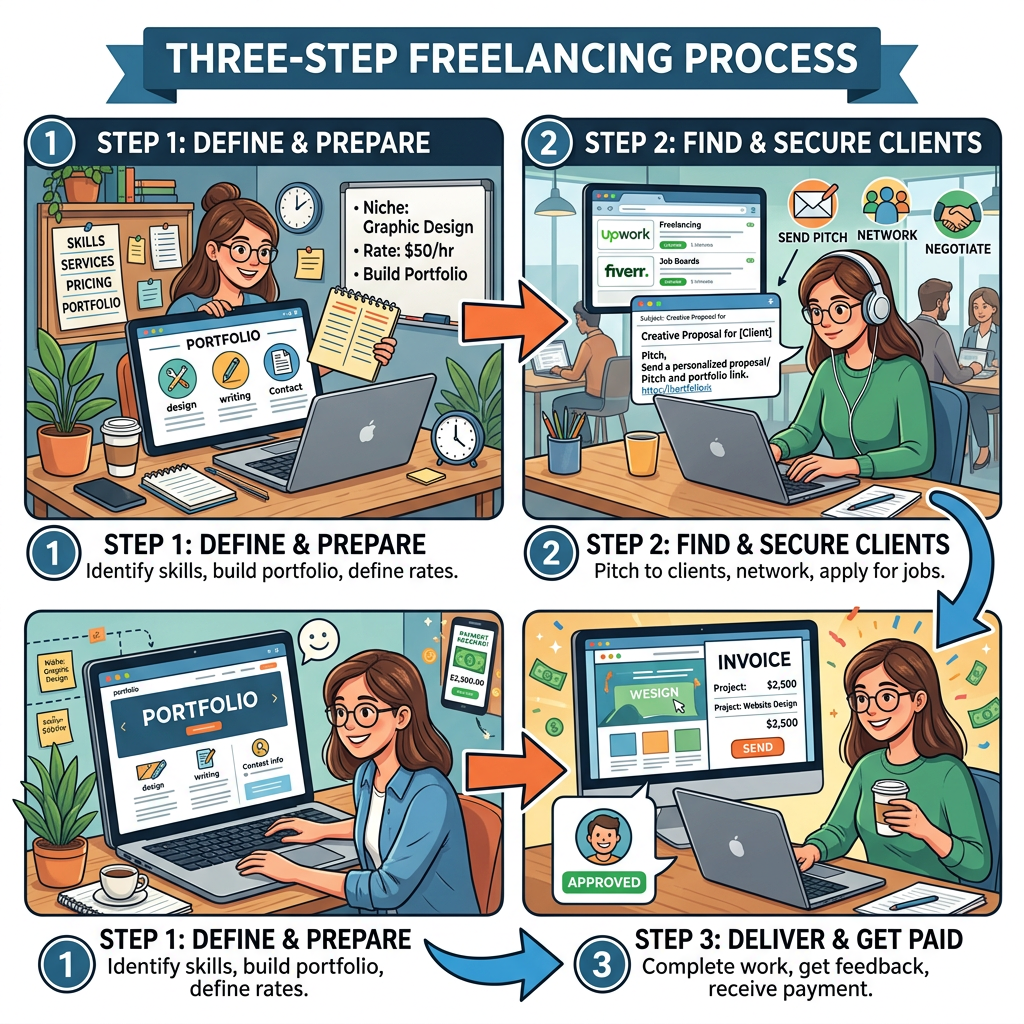
A clean, editorial illustration showing three sequential steps laid out horizontally. Step 1: a person with a clipboard doing a self-inventory — lists and notes around them. Step 2: a person sitting at a laptop building a simple professional profile, a LinkedIn-style page visible on screen. Step 3: the same person shaking hands (or in a video call) with a first client — expressions of mutual professional respect on both sides. The three steps are connected by a simple directional arrow. The illustration style is warm and approachable — not clinical or corporate. Color palette: deep teal, warm amber, cream. Clean modern editorial illustration.

Step 4: Find Your First Client — The Right Way
Here’s the thing nobody tells you clearly: the right way to find your first freelance client as a senior is almost certainly not through a freelance platform.
Platforms like Upwork and Fiverr are powerful tools. They’re also competitive environments where younger, less experienced workers undercut established professionals on price — and where building a reputation from zero takes time.
Most seniors who freelance successfully bypass this problem entirely for their first clients. They go to the people who already know them.
The Network-First Approach
Your professional and personal network is your most valuable asset. Use it before you use anything else.
Write a short, direct email or message to 10 to 20 people in your network — former colleagues, professional contacts, friends who run businesses. You’re not begging for work. You’re informing people who know and trust you that you’re now available.
The message can be simple. Something like:
“Hi David — I hope you’re doing well. I wanted to let you know that I’ve started doing freelance consulting work in HR and organizational development — drawing on my years at Meridian Group. I’m working with small and mid-sized companies that need experienced HR support without a full-time hire. If you know anyone who might benefit from that kind of help, I’d genuinely appreciate the introduction. Happy to have a quick call if you’d like to hear more.”
That’s it. No pitch deck. No formal proposal. Just a clear, specific message to people who already respect you.
In my own experience, this single step — done consistently over two or three weeks — generates the first client for the majority of seniors who try it.
When to Use Freelance Platforms
Platforms become useful once you have a defined service, a few client testimonials, and a clear sense of your positioning. At that point, Upwork in particular can be an effective way to reach clients outside your immediate network.
For specialized professional services, LinkedIn ProFinder is worth looking at. For writing and editing, Contently and ClearVoice are better alternatives to generalist platforms. For tutoring, Wyzant, Tutor.com, and Superprof are purpose-built for exactly this market.
Step 5: Set Your Rates — And Stick to Them
Undercharging is the most common and most damaging mistake that new senior freelancers make.
I understand the impulse. You feel uncertain. You don’t have a freelance track record yet. You want to make it easy for clients to say yes. So you name a number that’s lower than you know you’re worth — and you immediately attract the wrong clients, undermine your own positioning, and set a baseline that’s very hard to raise.
Here’s the reframe that helped me: you are not pricing your labor. You are pricing the outcome your expertise delivers.
A client who hires a retired compliance officer to review their regulatory documentation is not paying for hours of reading. They’re paying to avoid a costly regulatory violation. The value of that outcome is enormous relative to the cost of the service.
Practical Rate Guidance
Consulting (professional fields): $75 to $100 per hour for general professional consulting. $125 to $300 per hour for specialized high-stakes fields like healthcare, finance, law, or engineering. Many experienced consultants move to project-based or retainer pricing once they’ve established a relationship with a client.
Freelance writing: $0.10 to $0.25 per word for general content. $0.25 to $0.75 per word for specialized industry writing. $50 to $100 per hour for editing. Ghostwriting commands a significant premium — often $75 to $150 per hour — because clients are buying both skill and discretion.
Tutoring and teaching: $25 to $50 per hour for general academic subjects. $50 to $100 per hour for professional skills and specialized knowledge. Online courses created once and sold repeatedly can generate ongoing passive income at any price point.
Virtual assistance: $20 to $35 per hour for general VA work. $40 to $75 per hour for specialized VA work (bookkeeping, legal, medical office support).
The simple rule: research what others in your specific service area are charging. Set your rate at the midpoint or above. Adjust based on feedback — if every client immediately says yes without negotiating, you’re almost certainly undercharging.
A warm, editorial-style illustration showing a senior professional man in his late 60s at a video call on his laptop, speaking confidently to a client visible on his screen. On his desk: a simple notepad with a rate sheet, a coffee mug, a few organized papers. His posture is relaxed but authoritative — this is someone comfortable with professional conversations. Natural light from a window. The mood is competent and calm. Behind him, a home office environment that feels established and professional without being corporate. Color palette: warm navy, cream, amber. Editorial lifestyle illustration.

Step 6: Handle the Practical Details Early
The administrative side of freelancing trips up a lot of people who are excellent at the actual work. Set these things up before your first client engagement — not after.
Contracts and Agreements
Every freelance engagement, no matter how small or how well you know the client, should have a written agreement. It doesn’t have to be a complicated legal document. A one-page email confirmation that covers the scope of work, the rate, the payment schedule, and the timeline is often enough for smaller projects.
For larger or ongoing engagements, a simple service agreement template — available free from resources like LegalZoom, Rocket Lawyer, or even a Google search — provides real protection for both parties.
Invoicing
You need a way to send professional invoices and track payments. Free tools like Wave or PayPal invoicing handle this completely for most freelancers. If you do bookkeeping work or have multiple clients, QuickBooks Self-Employed is worth the modest monthly cost.
Taxes
Freelance income is self-employment income. Two things to know immediately:
First, set aside 25 to 30 percent of every payment for taxes. Freelancers pay both the employee and employer portions of Social Security and Medicare taxes, which surprises people who haven’t been self-employed before.
Second, if you expect to owe more than $1,000 in federal taxes for the year, you’re required to make quarterly estimated payments. The IRS website has a straightforward calculator. A one-time meeting with a CPA who handles self-employment taxes is genuinely worth the cost — it sets you up correctly from the beginning and answers every question at once.
The Social Security Question
If you’re collecting Social Security before your full retirement age, earned income above roughly $22,320 per year (2026 figure) temporarily reduces your benefits. Once you reach full retirement age, there’s no limit.
This doesn’t mean you shouldn’t freelance. It means you should know the specific numbers for your situation and plan accordingly. Your local Social Security office or a financial advisor can walk you through the math in 20 minutes.
What the First Six Months Actually Look Like
I want to be honest about this because the reality is different from the expectation — in both directions.
The first month is usually slow. Sometimes discouraging. You put your profile up, you send your network messages, and then you wait. The waiting is normal. It doesn’t mean it isn’t working.
The second and third months are typically when the first real traction appears. A former colleague introduces you to a potential client. Someone responds to your LinkedIn post. A referral comes through from someone you hadn’t expected.
By months four through six, the pattern begins to emerge. You start to understand which types of clients you work best with. You get clearer on what to charge and how to describe what you offer. The work starts to feel natural rather than uncertain.
Most senior freelancers I know describe a specific moment somewhere in that period when it clicks — when freelancing stops feeling like a temporary experiment and starts feeling like a legitimate, satisfying part of their lives. That moment comes at different times for different people. But it comes.
A warm, optimistic editorial illustration showing a six-month timeline represented as a winding path through four distinct “scenes.” Month 1: a person setting up a profile and sending messages — uncertain but determined. Months 2–3: a first video call, a handshake, a first invoice sent — the beginning of traction. Months 4–5: two or three clients visible, work in progress, a sense of growing momentum. Month 6: the same person at their desk, relaxed and settled, multiple projects organized, an expression of genuine satisfaction. The illustration conveys a journey — not a straight line, but a real one.

Summary and Key Takeaways
Freelancing as a senior is not a younger person’s game played on disadvantageous terms. It’s a different game entirely — one where the decades of experience, relationships, and hard-won judgment you’ve accumulated become genuine competitive advantages rather than irrelevant history.
The path is simpler than most people expect. Know what you offer. Choose a clear direction. Build a basic professional presence. Go to your network first. Set rates that reflect your actual value. Handle the administrative basics before your first engagement. Give it six months before judging the results.
None of that requires a tech background, a large budget, or a personality transplant. It requires clarity, patience, and the willingness to bet on what you’ve spent a career becoming.
10 Key Tips for Seniors Starting Freelance Work
1. Start with a skills inventory, not a platform. Know specifically what you’re offering before you worry about where to offer it. Clarity about your value comes first.
2. Go to your network before any platform. Your first client is almost certainly someone who already knows you, or someone they know. Start there. Platforms come later.
3. Pick one direction for the first six months. Generalists get ignored. Specialists get hired. Choose one service, for one kind of client, and focus there until you have traction.
4. Update your LinkedIn before anything else. A clear, current LinkedIn profile does the work of a website at no cost. Make sure your headline reflects what you offer now — not what you did before.
5. Price based on the value you deliver, not your uncertainty. Undercharging is a trap. Research the market. Set your rate at or above the midpoint. The right clients will pay for genuine expertise.
6. Get a simple written agreement for every engagement. Even with people you trust. It protects both parties and prevents misunderstandings about scope, timeline, and payment.
7. Set aside taxes from payment one. Twenty-five to thirty percent of every freelance payment. This is not optional — and discovering it late is genuinely painful.
8. Understand your Social Security earnings limit. If you’re collecting before full retirement age, know the threshold and plan around it. A financial advisor or Social Security office visit answers this quickly.
9. Give it six months before judging. The first month is slow for almost everyone. The momentum that makes freelancing genuinely worthwhile almost always takes three to six months to build. Don’t quit before it arrives.
10. Design for the life you want, not just the income you need. The greatest advantage of freelancing is the ability to choose — clients, hours, projects, pace. Use that freedom deliberately. The work should fit your life, not consume it.
This article is for informational purposes only. Earnings figures are approximate and vary significantly based on field, experience, location, and individual circumstances. Consult a financial advisor or tax professional before making significant changes to your retirement income structure.
Tags: Freelancing for Seniors | How to Start Freelancing | Retirement Income | Work From Home After 60 | Senior Freelancer Guide | Second Career After Retirement
© 2026 SummitSelect.org — All Rights Reserved
It’s never too late to learn, grow, and discover new possibilities.
Explore the books of Han Jong-Woo, where artificial intelligence, lifelong learning, personal growth, and meaningful living come together to inspire your next chapter.
Whether you’re curious about AI, seeking purpose, or simply looking for fresh inspiration, you’ll find books designed to encourage, empower, and enrich your life.
▶ Visit Han Jong-Woo’s Amazon Author Page and discover all of his books today.
Leave a Reply