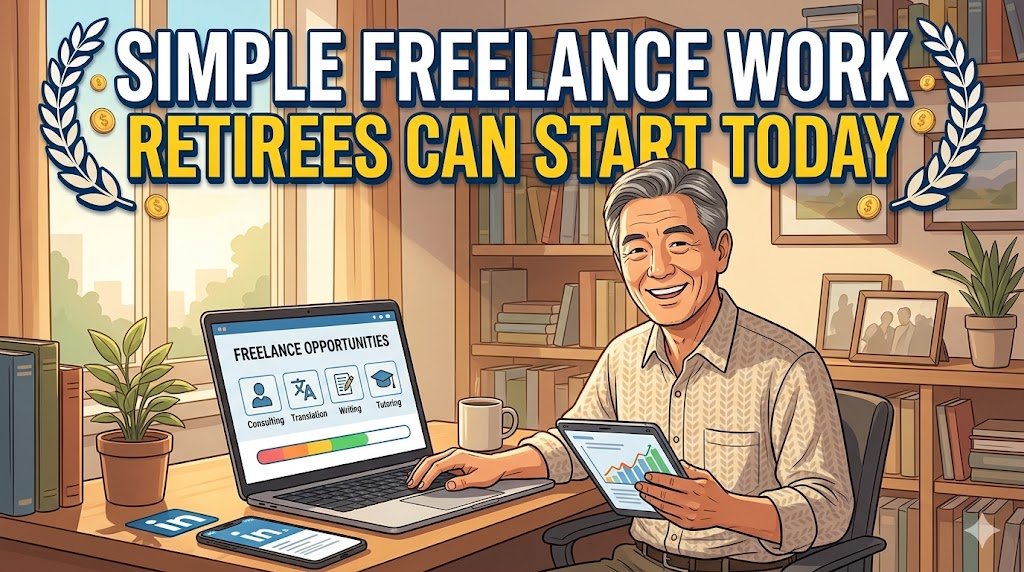
By Robert Callahan | Updated April 2026 | ~11 min read SummitSelect.org | Retirement & Income | Freelance & Side Work
The Bottom Line — Read This First
Retirement is supposed to be the finish line. But for a lot of people — more than anyone expected — it turns out to be more of a starting gate.
Not because they ran out of money. Not because they failed at retiring. But because six months in, the silence gets loud. The structure disappears. And something that felt like freedom starts feeling a lot like aimlessness.
Freelance work solves this elegantly — and the version available to retirees today looks nothing like the grueling hustle-culture freelancing you might be picturing. We’re talking about flexible, part-time, often remote work that draws on what you already know. Work you can start with almost no upfront investment. Work that supplements your income without compromising your Social Security benefits if structured correctly.
I’ve watched dozens of retirees start freelance work in the past few years. The ones who thrive share one trait: they stopped thinking about what they could no longer do and started thinking clearly about what they already knew how to do better than most people half their age.
That’s where this guide starts.
👉 “Don’t Just Retire, Bloom Again with AI!”
Are you ready to design a life of purpose, creativity, and connection after 60?
I spent my career accumulating real-world business wisdom. At 70, I discovered a powerful truth: AI isn’t just for the young. It’s the ultimate tool for us to transform our lifelong experience into a legacy.
My debut book, AI for Meaningful Living after 60, is your guide to Bridging the gap between your wisdom and wealth in the digital era.
It’s not about complex coding. It’s about practical steps to use AI to unleash your creativity, deepen your connections, and find daily joy.
👉 [Get Your Practical Guide to a Meaningful Retirement on Amazon Now! (Click Here)]
Introduction: Why Freelancing Makes Particular Sense for Retirees
There’s a version of freelancing that sounds exhausting. Cold pitching strangers. Building a brand from scratch. Grinding through rejection after rejection hoping someone takes a chance on you.
That’s not what most retirees are doing — and it’s not what this article is about.
Retirees who freelance successfully are largely doing one thing: converting decades of accumulated expertise into a flexible, self-directed income stream. They’re not starting from zero. They’re starting from an enormous base of knowledge, skills, and relationships that younger freelancers spend years trying to build.
The difference is significant. A 28-year-old freelance writer is competing on price and hustle. A 62-year-old retired pharmaceutical executive offering medical writing or regulatory consulting is competing on knowledge that simply cannot be rushed into existence. The market for the latter is smaller — and the rates are considerably higher.
This is the model that works. Not competing with the young. Offering what the young genuinely cannot replicate.
What the Numbers Show
The freelance economy has grown dramatically over the past decade. According to Upwork’s annual freelancing report, adults over 55 are now the fastest-growing segment of the freelance workforce. They report higher job satisfaction, higher average hourly rates, and lower rates of client turnover than their younger counterparts.
The reason is simple. Clients who need experienced judgment are willing to pay for it — and retirees have it in abundance.
A warm, editorial-style photograph of a man in his mid-60s working comfortably at a standing desk in a bright home office. He is on a video call — a laptop open, small notepad beside it — with the relaxed, focused expression of someone in their professional element. Behind him, natural light through large windows, a few tasteful books on a shelf. The mood is purposeful and calm — not hectic or corporate. He looks like someone doing exactly what he’s good at, on his own schedule. Warm natural tones, shallow depth of field. Editorial lifestyle feel.

1. Consulting in Your Former Field
This is the most direct path — and for many retirees, the most immediately lucrative one.
You spent 20, 30, maybe 40 years developing expertise in a specific field. Healthcare administration. Financial management. Human resources. Engineering. Marketing. Supply chain. Legal compliance. Education administration. The list is as long as the list of careers.
When you retire, that expertise doesn’t expire. Small and mid-sized businesses, nonprofits, and startups often need exactly the kind of seasoned judgment you have — and they can’t afford, or don’t need, a full-time senior hire to get it.
That’s where you come in.
What it looks like in practice: You work with one or two clients at a time, typically 10 to 20 hours per week. You charge by the hour or by the project. You work remotely for most of it, with occasional meetings. You set your own schedule.
What to charge: Entry-level consulting rates for experienced professionals typically start at $75 to $100 per hour. Specialists in high-value fields — healthcare, finance, law, engineering — commonly charge $150 to $300 or more.
How to start: Before you do anything else, reach out to three to five people in your former professional network and tell them what you’re doing. Don’t pitch. Just let them know you’re available for consulting work and ask if they know anyone who might benefit. That conversation alone launches more consulting practices than any amount of website building or cold outreach.
My former colleague Bill retired from a 28-year career in hospital administration. Within three weeks of telling his network he was available, he had two small community hospitals asking if he could help them with compliance reviews. He billed 15 hours a week for the first year and earned more per hour than he had in his last salaried position.
2. Freelance Writing and Editing
Writing is one of the most accessible freelance paths for retirees — and it’s dramatically underestimated by people who think it means competing with English majors for low-paying content mill work.
The writing market that works for experienced retirees is different. It’s specialized. It’s knowledge-based. And it pays accordingly.
What Types of Writing Pay Well
Technical and industry writing — If you spent your career in a specific field, you can write for publications, associations, and companies in that field. A retired nurse writing for healthcare publications. A retired engineer writing technical documentation. A retired CFO writing financial commentary for a trade magazine.
Grant writing — Nonprofits desperately need grant writers and there is a significant shortage of good ones. If you have experience in nonprofit work, government, or social services, grant writing is one of the highest-demand freelance skills available. Rates typically range from $50 to $100 per hour, and experienced grant writers often work on retainer.
Business writing and ghostwriting — Business owners, executives, and entrepreneurs frequently need help writing articles, speeches, white papers, and even books under their own names. If you’re a strong writer with business experience, ghostwriting pays very well — often $50 to $150 per hour — and the work is usually interesting.
Copyediting and proofreading — If you have a strong eye for language and grammar, editing is a quieter path into freelance writing work. Academic editing, manuscript editing, and business document editing are all steady markets.
How to start: Create a simple portfolio of two or three writing samples — even if you have to write them specifically to demonstrate your range. Post a profile on Upwork or ProFinder. Reach out to trade publications in your former field and ask about contributor opportunities. Most publications accept pitches from people with genuine expertise, regardless of traditional journalism experience.
A clean, warm editorial illustration showing a split-screen of three different retirees doing freelance work at home. Top left: a woman in her late 60s writing intently at a sunlit desk with a cup of tea nearby — representing freelance writing. Bottom left: a man in his early 70s on a video call with a whiteboard behind him covered in organized notes — representing consulting. Right side (larger): a woman in her mid-60s at a kitchen table with crafts and a laptop open to an online marketplace — representing product-based freelance work. The overall mood is warm, independent, and quietly productive. Color palette: soft creams, warm amber, sage green. Editorial lifestyle illustration style.

3. Online Tutoring and Teaching
If you enjoyed any aspect of explaining things, mentoring colleagues, or training people throughout your career, online tutoring and teaching is one of the most satisfying freelance paths available to retirees.
The market is large and genuinely hungry for qualified instructors. And the range of what people want to learn is far broader than most retirees realize.
What You Can Teach
Academic subjects — Math, science, English, history, foreign languages. If you have a degree and some patience, platforms like Tutor.com, Wyzant, and Varsity Tutors connect you directly with students. Rates range from $25 to $80 per hour depending on subject and level.
Professional skills — This is where experienced retirees have a real advantage. Business communication, Excel, QuickBooks, professional writing, project management, public speaking. These skills are in enormous demand from adult learners, career changers, and small business owners.
Life skills and continuing education — Cooking, photography, genealogy research, watercolor painting, financial literacy for young adults, gardening. Platforms like Skillshare and Teachable allow you to record a course once and earn ongoing income as students enroll.
English as a second language — ESOL tutoring is one of the most consistent and flexible freelance teaching opportunities available. Platforms like iTalki connect tutors with students worldwide. No teaching certification is required for conversational practice sessions.
What makes retirees particularly good at this: Patience. Real-world context. The ability to explain why something matters, not just how it works. These are qualities that younger tutors frequently lack — and that students, especially adult students, deeply value.
4. Virtual Assistant Work
The term “virtual assistant” covers a surprisingly wide range of work — and some of it is ideally suited to organized, detail-oriented retirees who want steady, predictable part-time work.
Virtual assistants help business owners, entrepreneurs, and professionals with tasks they need done but don’t have time to do themselves. The specific tasks vary enormously by client.
What Virtual Assistants Actually Do
Email and calendar management — Monitoring an inbox, filtering important messages, scheduling appointments, sending follow-up reminders. This is among the most commonly requested VA tasks.
Research and data organization — Finding information, compiling reports, organizing spreadsheets, fact-checking documents.
Social media management — Scheduling posts, responding to comments, basic content creation for small businesses that have a social presence but no dedicated staff.
Customer service support — Answering standard inquiries, managing customer email queues, processing simple requests.
Bookkeeping support — Basic QuickBooks or spreadsheet work for small businesses. If you have an accounting or bookkeeping background, this subset commands higher rates.
What it pays: Entry-level VA work typically pays $15 to $25 per hour. Specialized VAs with specific skills — project management, bookkeeping, legal support, medical office experience — commonly earn $35 to $60 per hour or more.
How to get started: Platforms like Belay, Time Etc., and Fancy Hands specifically recruit experienced, mature virtual assistants. A profile on Upwork highlighting your organizational background and professional experience is another effective starting point.
5. Handmade Products and Artisan Work
Not every retirement freelance path involves a screen.
If you have a craft or artisan skill — woodworking, knitting, jewelry making, ceramics, candle making, quilting, painting, photography — the market for handmade, high-quality goods has never been stronger. And the platforms for selling them have never been more accessible.
Etsy is the most well-known, but it’s far from the only option. Local craft fairs, farmers markets, and specialty boutiques are significant markets that don’t require any technology beyond a square card reader.
What Actually Sells
The handmade market rewards specificity and story. A generic wooden cutting board competes with mass-produced alternatives on price — and loses. A cutting board made from reclaimed barn wood by a retired carpenter in Vermont with 40 years of woodworking experience, sold with the story behind both the wood and the maker — that’s a different product. That sells at $95 and has a waiting list.
Your experience is part of what you’re selling. Don’t hide it. The story of how you learned your craft, how long you’ve practiced it, and what you put into each piece is genuine marketing — and it’s marketing no mass producer can replicate.
What it pays: Highly variable, and dependent on pricing strategy, marketing, and production volume. The retirees I know who do this successfully treat it as a lifestyle business — 10 to 15 hours per week, meaningful income, deeply satisfying work. They’re not trying to scale. They’re trying to sustain.
A warm, richly detailed editorial photograph of a woman in her late 60s in a bright, organized home studio. She is working on a piece of handmade jewelry — tools laid out neatly, finished pieces displayed on a simple wooden tray beside her. Her hands are skilled and confident. Natural light fills the space. On the corner of her workbench, a laptop is open, suggesting she sells online. The mood is peaceful, creative, and professionally accomplished — this is someone who takes her craft seriously. Warm natural tones, craft-studio aesthetic, no clutter or chaos. The image should feel aspirational and achievable simultaneously.

6. Bookkeeping for Small Businesses
Small businesses need bookkeepers desperately — and consistently underserve this need because good, reliable bookkeepers with real professional experience are hard to find.
If you have any background in accounting, finance, office management, or business administration, freelance bookkeeping is one of the most stable and well-compensated freelance paths available to retirees.
What It Involves
Most small business bookkeeping involves recording transactions, reconciling accounts, preparing basic reports, and keeping financial records organized and current. Software like QuickBooks and FreshBooks has made the technical side genuinely manageable — and if you already have bookkeeping experience, there’s a short learning curve even if the specific software is new to you.
What it pays: Freelance bookkeepers with professional experience typically charge $35 to $75 per hour. Many work with three to five small business clients on a monthly retainer — providing stable, predictable income without the variability of project-by-project work.
How to start: The bookkeeping path starts almost exclusively through personal referrals and local business networks. Talk to people at your local chamber of commerce. Mention to anyone who runs a small business that you’re available. One good client who spreads the word is worth more than a hundred cold applications.
A certification from the American Institute of Professional Bookkeepers (AIPB) adds credibility if you want it — but many experienced retirees secure clients on the strength of their professional background alone.
7. Pet Sitting and Dog Walking
I’m including this one because it’s consistently underestimated — and because the retirees I know who do it report some of the highest day-to-day satisfaction of any freelance path on this list.
The pet care industry has grown substantially. Working professionals need reliable, caring, experienced people to walk their dogs, check in on their cats, and house-sit when they travel. They’re not looking for a teenager who needs the cash. They’re looking for someone trustworthy, responsible, and genuinely good with animals.
That description fits a lot of retirees perfectly.
What it pays: Dog walking typically earns $20 to $30 per walk. Pet sitting and house-sitting ranges from $50 to $100 per day. Platforms like Rover and Wag connect pet sitters with clients in their local area.
Why retirees excel here: Availability during the day. Patience. Reliability. A settled, calm presence that anxious animals respond to well. These are not small things in a field where the primary concern is whether your pet will be genuinely cared for — not just supervised.
A joyful, warm editorial photograph of a man in his late 60s walking two dogs in a quiet residential neighborhood on a sunny morning. He looks genuinely happy — not performing happiness for a camera, but actually enjoying himself. The dogs are calm and well-behaved. He is dressed simply and comfortably. The neighborhood behind him has mature trees and well-kept homes. The mood is active, healthy, and contented. This image should capture the specific kind of satisfaction that comes from simple, outdoor, purposeful physical work. Warm natural morning light. Candid editorial style.

Before You Start: A Few Practical Considerations
The Social Security Question
If you’re collecting Social Security before your full retirement age, earned income above a certain threshold temporarily reduces your benefits. In 2026, the earnings limit is approximately $22,320 per year if you haven’t reached full retirement age. Once you reach full retirement age, there’s no limit.
This doesn’t mean you shouldn’t freelance. It means you should know the numbers — and structure your work accordingly if necessary. A quick conversation with your Social Security office or a financial planner clarifies your specific situation.
Tax Basics
Freelance income is self-employment income. You’ll pay self-employment tax on top of income tax. Set aside approximately 25 to 30 percent of your freelance earnings for taxes, and make quarterly estimated tax payments if your annual tax liability will exceed $1,000.
None of this is complicated, but it surprises people who haven’t been self-employed before. A one-time consultation with a CPA who handles self-employment taxes will answer every question and set you up correctly from the beginning.
Starting Small Is Starting Right
Every experienced freelancer I know started with one client, one project, one small engagement. Not a business plan. Not a website. Not a brand. One client. One piece of work. Done well.
The discipline of starting small isn’t timidity. It’s how you learn what works, what you enjoy, and what the market actually wants from you — before you’ve committed to a specific direction.
Summary and Key Takeaways
Freelance work for retirees isn’t a consolation prize for people who couldn’t quite afford to stop working. For the people doing it well, it’s one of the more genuinely satisfying chapters of their professional lives.
The model is simple: take what you already know, translate it into a form the market needs, and offer it flexibly on terms that suit your life. Not the reverse.
The seven paths in this guide represent a range of income levels, skill requirements, and lifestyle fits — from high-value consulting that builds directly on a career’s worth of expertise, to physically active work like dog walking that provides structure, fresh air, and genuine human (and animal) connection.
What they share: they’re all genuinely accessible to someone starting today. No significant upfront investment. No special equipment in most cases. No need to become someone different than you already are.
10 Key Tips for Retirees Starting Freelance Work
1. Start with your network, not a job board. The fastest path to your first freelance client is someone who already knows you. Tell people what you’re doing before you build a single website or profile.
2. Price based on your expertise, not your anxiety. The most common mistake new freelancers make — at any age — is undercharging. Your decades of experience have real market value. Charge accordingly.
3. Start with one client. Not a business. Not a brand. One client. One project. Done well. Scale from there.
4. Know your Social Security earnings limit. If you’re collecting benefits before full retirement age, understand how earned income affects your payments. A financial advisor or Social Security office visit clarifies this quickly.
5. Set aside 25 to 30 percent for taxes. Freelance income is self-employment income. The tax treatment is different from a salary. Prepare for it from your very first payment.
6. Choose work that energizes you, not just work that pays. The flexibility of freelance work means you have genuine choice. Use it. Work you find meaningful sustains itself over years. Work you endure burns out quickly.
7. Define your hours from the beginning. One of the greatest risks of freelancing is scope creep — clients who gradually expect more than the original agreement. Set clear expectations about availability and working hours before you start.
8. Keep a simple record of everything. Hours worked, invoices sent, payments received, expenses. A basic spreadsheet handles all of this. You’ll thank yourself at tax time.
9. Don’t wait until everything is perfect to start. There’s no perfect moment, no perfect website, no perfect portfolio. The learning happens by doing. Start imperfectly and improve in motion.
10. Give it six months before judging. Freelance work takes time to build. The first month is slow for almost everyone. The clients, referrals, and momentum that make it genuinely worthwhile typically appear between months three and six. Give yourself the runway to get there.
This article is for informational purposes only. Earnings figures are approximate and vary based on experience, location, and market conditions. Consult a financial advisor or tax professional before making significant changes to your income structure in retirement.
Tags: Freelance Work for Retirees | Retirement Income | Part-Time Work After 60 | Work From Home Seniors | Second Career | Encore Income
© 2026 SummitSelect.org — All Rights Reserved
It’s never too late to learn, grow, and discover new possibilities.
Explore the books of Han Jong-Woo, where artificial intelligence, lifelong learning, personal growth, and meaningful living come together to inspire your next chapter.
Whether you’re curious about AI, seeking purpose, or simply looking for fresh inspiration, you’ll find books designed to encourage, empower, and enrich your life.
▶ Visit Han Jong-Woo’s Amazon Author Page and discover all of his books today.
Leave a Reply