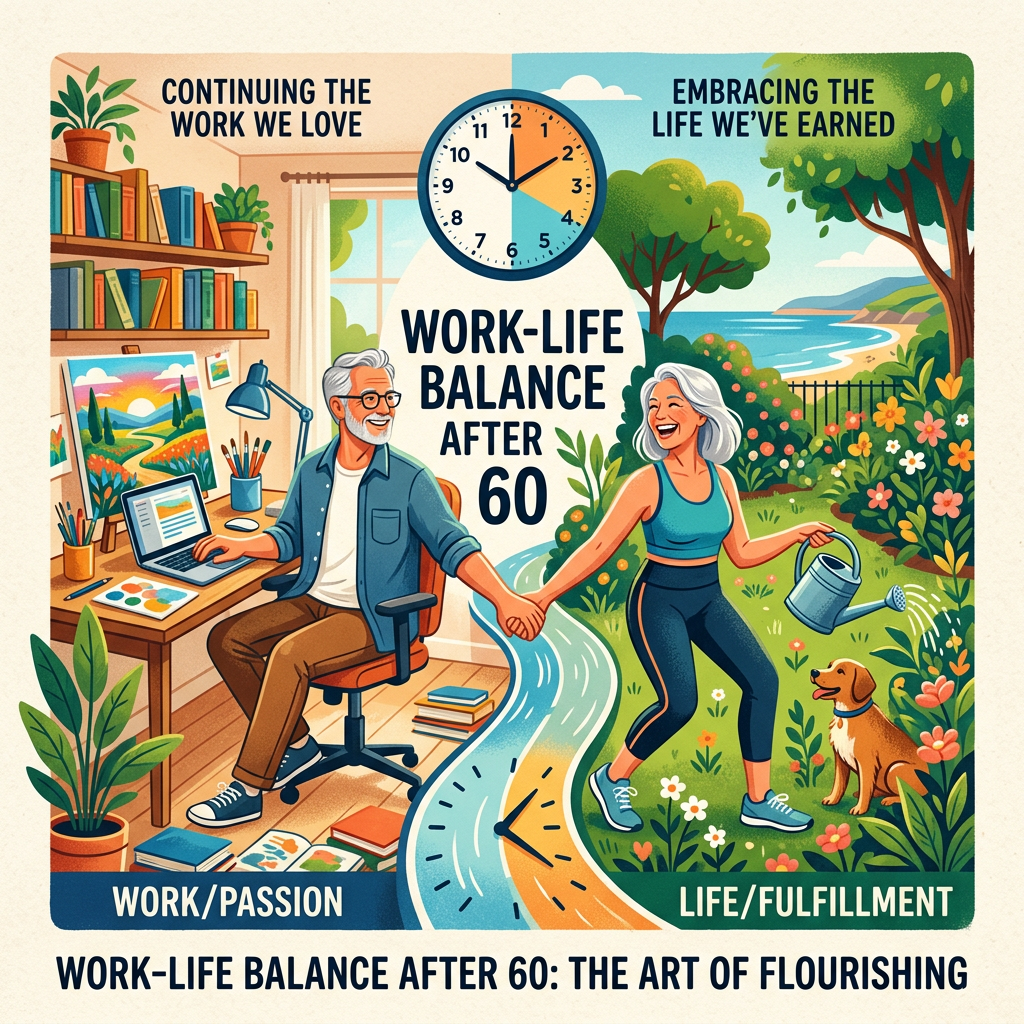
By Han Jong-woo | Updated April 2026 | ~12 min read SummitSelect.org | Life After 60 | Health & Wellbeing | Second Career
The Bottom Line — Read This First
I used to think work-life balance was a young person’s problem.
When I was in my 30s and 40s, I heard colleagues talk about it constantly. Too many hours. Not enough family time. The guilt of missing school plays and weekend soccer games. I understood it abstractly, but I was still in the mode where work was the center of gravity around which everything else orbited.
Then I turned 60.
And suddenly the question flipped completely. Instead of wondering how to carve out more time for life around a demanding career, I found myself wondering how to carve out meaningful work around a life that had suddenly expanded in every direction. More time. More freedom. And — if I’m being honest — more uncertainty about what to do with both.
The work-life balance question after 60 is fundamentally different from what it is at 35. The challenge isn’t usually too much work crowding out life. The challenge is figuring out what work actually means now, how much of it you actually want, and how to integrate it with a life that’s changing in ways nobody quite prepared you for.
I’ve spent the last several years thinking hard about this — through my own experience, through dozens of conversations with people navigating this same territory, and through the research that’s accumulated on wellbeing in the second half of life. What follows is the most honest and practical version of what I’ve learned.
Introduction: Why the Old Framework Doesn’t Fit Anymore
The standard work-life balance conversation assumes a fixed structure: a demanding job that pulls you toward work, a full life outside it pulling you toward everything else, and the daily negotiation between the two.
After 60, that structure often disappears or fundamentally changes.
Maybe you’ve retired fully and discovered that pure leisure, despite its appeal in theory, produces its own form of restlessness. Maybe you’re still working but want to work differently — fewer hours, different pace, different relationship to the outcomes. Maybe you’re in a second career that doesn’t feel like “work” in the traditional sense, which creates its own confusions about boundaries and sustainability. Maybe you’re caring for a spouse or aging parent in ways that reorganize everything else.
Whatever the specific configuration, the old framework — job on one side, life on the other, find the balance point — usually doesn’t capture what’s actually going on.
What I’ve found more useful is a different frame entirely: instead of “balance,” think about integration. What does a life look like where meaningful work, genuine rest, real relationships, and personal purpose are woven together in ways that sustain you — not perfectly, not statically, but sustainably over years?
That’s the question this article is really about.

What the Research Actually Says About Wellbeing After 60
Before I get into what’s worked for me and the people I know, I want to spend a moment on what the research says — because some of it surprised me.
The standard assumption is that retirement brings happiness. Leave work, gain freedom, feel better. The data is considerably more complicated.
Studies from the National Bureau of Economic Research and several major longitudinal studies on aging consistently show that the relationship between retirement and wellbeing is highly individual and highly dependent on how retirement is structured. Full, abrupt retirement — especially for people who defined significant portions of their identity through work — is associated with increased rates of depression, cognitive decline, and in some studies, reduced longevity.
Partial retirement and what researchers call “bridge employment” — reduced work that transitions between full career and full retirement — is associated with significantly better outcomes across multiple wellbeing measures.
The research on purpose is equally clear. Having a sense of purpose — a feeling that your days contain something that matters beyond your own immediate comfort — is one of the strongest predictors of healthy aging across every study that’s looked at it seriously. More predictive than income above a moderate level. More predictive than social activity per se. The quality of the activity — whether it feels meaningful — matters more than the quantity.
What this means practically: the goal after 60 isn’t more leisure. The goal is the right mix of meaningful engagement and genuine rest, structured in a way that’s sustainable for your specific energy, health, relationships, and values.
Finding that mix is the actual work. And it’s worth taking seriously.
The Four Dimensions of Wellbeing After 60
I’ve come to think of work-life balance after 60 as a four-part equation, with each dimension needing conscious attention.
Dimension One: Meaningful Work — But on Your Terms
Work after 60 doesn’t have to look like work before 60.
This sounds obvious when stated directly. In practice, it took me a long time to actually believe it. I kept unconsciously applying the old standards — hours worked, income generated, titles held, the relentless forward momentum of a career in its building phase — to a situation where none of those standards applied.
The meaningful work that sustains people after 60 tends to share several characteristics. It’s self-directed rather than externally directed. It draws on accumulated experience rather than requiring the acquisition of entirely new expertise. It has some relationship to what the person actually values — not just what they’re good at or what pays. And critically, it has limits. It doesn’t consume everything.
For some people this is consulting work that draws on a long professional career. For others it’s teaching, or writing, or volunteer leadership, or part-time work in a completely different field from the one they spent 30 years in. For some people the meaningful work is caregiving — for grandchildren, for aging parents, for the community.
The form is less important than the function. What matters is that it provides structure, stimulation, and a feeling that your days contain something that matters.
Dimension Two: Rest That’s Actually Restorative
This is where I think people over 60 most consistently get things wrong — including me, for several years.
We conflate rest with inactivity. We assume that because we’re tired, we need to do nothing. And then we do nothing, and we feel worse, and we’re confused.
Restorative rest is not the same as inactivity. Genuine restoration — the kind that actually refills the reserves that meaningful work depletes — is specific to each person and needs to be identified consciously rather than assumed.
For some people, genuine restoration is physical — a long walk, a swim, gardening, time in nature. For others it’s deeply social — conversation with close friends, time with grandchildren, community involvement. For others it’s creative — reading, music, making things. For others it’s genuinely quiet and solitary — meditation, journaling, time with no demands on them at all.
Most people need some of all of these. The ratio is individual.
What doesn’t work as restoration — despite appearing restful — is passive consumption: hours of television, endless scrolling, the kind of distraction that feels like rest in the moment but leaves you feeling empty rather than refilled.
Identifying your genuine restoration activities — specifically, by paying attention to what actually leaves you feeling better rather than what seems like it should — is one of the most practically important things you can do for your wellbeing after 60.
Dimension Three: Relationships That Sustain You
The research on loneliness in older adults is, frankly, alarming. One in three adults over 45 reports significant loneliness. The health consequences — well-documented across dozens of studies — are serious enough that researchers describe social isolation as a health risk comparable to smoking.
Relationships are not a luxury or a nice-to-have in the work-life balance equation after 60. They are a genuine health requirement.
But relationships also require active investment in a way that’s easy to underestimate, especially for people who got their social needs met primarily through work for 30 years.
When work structures disappear — or change — the social infrastructure built around them often disappears too. Former colleagues move on. Professional networks thin. The casual daily social contact of an office environment suddenly isn’t there.
Building and maintaining relationships after 60 requires intention in a way it didn’t before. The people I know who navigate this well are consistently proactive about social connection — not waiting for it to happen, but creating the structures and habits that make it happen reliably.
Dimension Four: Health as the Foundation
None of the other three dimensions work if the physical foundation is crumbling.
I know this sounds obvious. I also know, from watching myself and the people around me, how easy it is to treat physical health as something to attend to after everything else is handled — rather than as the non-negotiable foundation that determines whether everything else is possible.
After 60, the body gives clearer and earlier signals about what it needs. Sleep becomes more important and more vulnerable. The consequences of sustained stress are less buffered by the resilience of youth. The relationship between physical activity and mental and emotional wellbeing becomes increasingly direct and unmistakable.
The people I know who are navigating life after 60 most successfully are almost universally the ones who treat physical health — sleep, movement, nutrition, stress management — as a primary commitment rather than a secondary consideration.

What Actually Throws It Off — The Real Disruptors
Understanding what disrupts work-life integration after 60 is as important as understanding what builds it. These are the patterns I’ve seen most consistently.
The Identity Vacuum
This is the one nobody wants to admit.
For most people who spent significant careers in demanding fields, professional identity is deeply woven into personal identity. Who you are and what you do are not separate things — they’ve been integrated for decades.
When the professional role changes or disappears, the identity question becomes urgent in a way it hasn’t been since early adulthood. Who am I without the title? What gives me the right to be taken seriously? What do I have to offer?
The people who navigate this well tend to have two things: genuine interests outside of their professional identity that were developed over their careers, and the willingness to sit with the discomfort of transition rather than rushing to fill the vacuum with the first available option.
The people who navigate it badly tend to either cling to the old identity long past its relevance — still describing themselves primarily in terms of a role they left years ago — or rush into activity without doing the inner work of figuring out what they actually want this chapter to contain.
Boundary Collapse in the Other Direction
I’ve watched several friends in second careers or consulting practices fall into a pattern that’s the mirror image of the work-family conflict of their earlier years.
Instead of work crowding out everything else, everything else gradually crowds out work. Grandchild care. Home projects. Social commitments. Travel. Volunteer obligations. The flexibility of the second career means nothing has fixed hours, which means the boundaries that used to be structurally enforced have to be created consciously — and often aren’t.
The result is a feeling of being perpetually busy without being particularly productive, and a second career that never gains real traction because it never gets sustained focus.
Boundaries after 60 are counterintuitively important — not to protect life from work, but to protect work from life. Dedicated hours. Clear expectations with the people around you. The discipline to treat your professional commitments as real commitments rather than aspirational ones.
Caregiver Overload
This is the disruptor that hits unexpectedly and hardest.
A significant proportion of people in their 60s find themselves simultaneously navigating their own career or retirement transition and becoming primary or secondary caregivers — for aging parents, for spouses with health challenges, sometimes for grandchildren.
Caregiving done well is meaningful. Caregiving done without structure, without support, and without clear boundaries is one of the most reliable routes to burnout, health decline, and profound loss of self that exists.
If caregiving is part of your life — or increasingly likely to become part of it — planning for it as a structural element rather than an unexpected interruption is essential. What does the caregiving require? What support is available? What do you need to protect in yourself to provide care sustainably rather than running yourself into the ground?
These are not comfortable questions. They’re necessary ones.

Building Your Own Framework — The Practical Part
Principles without practice are just philosophy. Here’s how I’ve found it most useful to actually construct a work-life framework that works after 60.
Start With a Weekly Architecture
Most people who struggle with work-life balance after 60 are operating without a clear weekly structure. They’re responding to what comes up — to requests, to obligations, to the daily pull of whatever feels most urgent — rather than operating from an intentional framework.
A weekly architecture is simple. It’s not a rigid schedule. It’s a set of decisions made in advance about what happens when.
What days or mornings are dedicated to professional work — with real focus, real boundaries, real protection from interruption? What time is dedicated to physical health — specifically, not aspirationally? What recurring social commitments exist that nourish the important relationships? What time is genuinely unstructured — free of productivity expectations in either direction?
Sketch this out on paper. Not as a perfect ideal, but as a genuine intention. Then live in it for a month and see where it holds and where it breaks down.
The breakdowns are informative. They show you where your stated priorities and your actual behavior diverge — which is always where the real work is.
The Quarterly Review
One thing that genuinely helps — and that I’ve recommended to enough people to be confident it works — is a quarterly personal review.
Every three months, set aside a few hours to honestly evaluate how the previous quarter went across the four dimensions: meaningful work, genuine rest, sustaining relationships, and physical health.
Not a performance review. A reality check. Where did the integration work? Where did it collapse? What surprised you? What needs to change?
This sounds like a corporate exercise transplanted to personal life. It works anyway. The act of deliberately examining how you’re spending your time and energy, at regular intervals, is one of the most reliable ways to catch drift before it becomes a problem and maintain genuine intention about how you’re living.
Permission to Change the Formula
The last thing I want to say about building a work-life framework after 60 is this: whatever you construct today will need to change.
Health changes. Family situations change. The work that felt deeply meaningful at 63 might feel complete at 68. The balance that worked beautifully while both partners were healthy might need complete reconstruction when that changes.
The goal is not to build a perfect static system. The goal is to develop the habit of paying attention, the willingness to be honest about what’s actually working, and the flexibility to make changes when the situation calls for them — without guilt, without treating change as failure.
Life after 60 is not a fixed destination. It’s a long, interesting, demanding stretch of road. The navigation requires ongoing adjustment, not a set-and-forget system.

Summary and Key Takeaways
Work-life balance after 60 is a fundamentally different challenge from what it was in earlier decades — and it deserves a fundamentally different approach.
The goal isn’t to find the midpoint between too much work and not enough. The goal is integration: meaningful work, genuine rest, sustaining relationships, and physical health woven together in ways that are sustainable and genuinely nourishing over the long term.
The disruptors — identity vacuum, boundary collapse, caregiver overload — are real and worth preparing for rather than reacting to. The building blocks — weekly architecture, quarterly review, and the willingness to adjust — are practical and genuinely usable.
Most importantly: this is ongoing work, not a problem to be solved once. The people who navigate life after 60 most successfully are the ones who treat their own wellbeing as a primary responsibility — not selfishly, but with the clear understanding that you cannot contribute meaningfully to anyone or anything from a position of depletion.
Take it seriously. Pay attention to it. Adjust when it needs adjustment.
That’s the whole framework.
10 Key Tips for Work-Life Balance After 60
1. Replace “balance” with “integration.” The old framework of work on one side and life on the other rarely fits after 60. Think instead about how meaningful work, genuine rest, good relationships, and physical health can be woven together sustainably.
2. Don’t underestimate the identity transition. For many people, the biggest challenge after 60 isn’t time management — it’s the loss of a professional identity that has been central for decades. Give this honest attention rather than rushing past it.
3. Identify your genuine restoration activities specifically. Not what seems restful — what actually leaves you feeling replenished. Pay attention to this distinction. It matters more than most people realize.
4. Treat relationships as a health requirement, not a luxury. The research on social connection and longevity is clear. Invest in relationships proactively and structurally — not just when it’s convenient.
5. Build a weekly architecture, not a daily schedule. Decide in advance what happens when — which days are for focused work, which time is for health, which commitments are recurring and protected. Live in it and adjust from reality.
6. Protect meaningful work from life as much as protecting life from work. In the second career or retirement transition, boundary collapse in both directions is possible. Give your meaningful work dedicated, protected time.
7. Plan for caregiving before you’re overwhelmed by it. If caregiving is part of your life or likely to become part of it, treat it as a structural element that requires planning — not an unexpected interruption that overrides everything else.
8. Do a quarterly reality check. Every three months, honestly evaluate how things are going across the four dimensions. Catch drift early. Adjust before small misalignments become large problems.
9. Build your physical health into the non-negotiable category. Sleep, movement, and stress management are not nice-to-haves after 60. They are the foundation on which everything else rests. Treat them accordingly.
10. Give yourself permission to change the formula. Whatever works today won’t work forever. That’s not failure — that’s life. The goal is ongoing attention and willingness to adjust, not a perfect static system.
This article reflects the author’s personal experience and observations. Individual circumstances vary significantly. For health or psychological concerns, please consult qualified professionals.
Tags: Work-Life Balance After 60 | Life After Retirement | Second Career Balance | Wellbeing After 60 | Healthy Aging | Work and Retirement | Senior Lifestyle Tips
© 2026 SummitSelect.org — All Rights Reserved
It’s never too late to learn, grow, and discover new possibilities.
Explore the books of Han Jong-Woo, where artificial intelligence, lifelong learning, personal growth, and meaningful living come together to inspire your next chapter.
Whether you’re curious about AI, seeking purpose, or simply looking for fresh inspiration, you’ll find books designed to encourage, empower, and enrich your life.
▶ Visit Han Jong-Woo’s Amazon Author Page and discover all of his books today.
Leave a Reply