From Retirement to Digital Entrepreneur: How I Built a $1,000 Monthly Passive Income with AI
👉 Start Your Journey: Access the Full 118-Page AI Blueprint Now
Conclusion
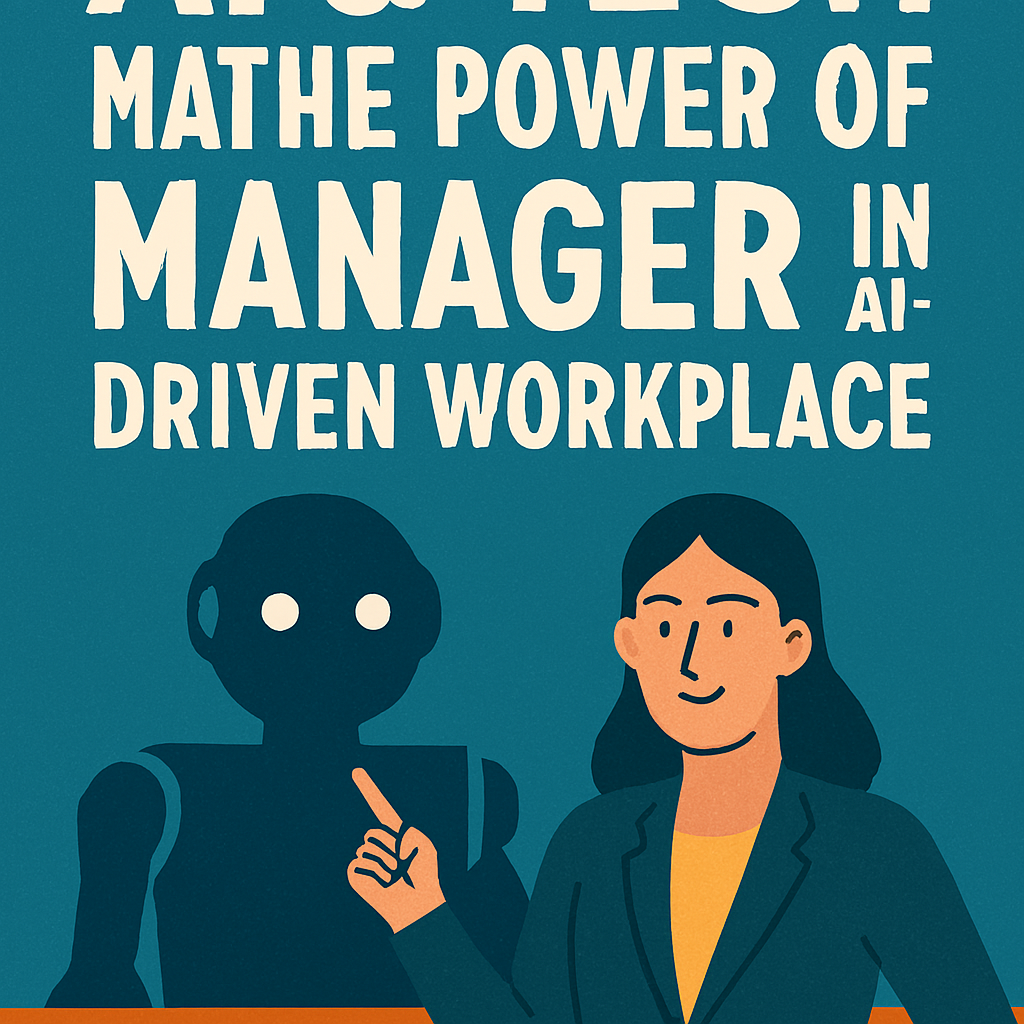
AI will not eliminate managers.
It will make good managers indispensable and bad managers obsolete.
As AI takes over tasks, analysis, and execution, the true bottleneck of performance shifts back to humans.
Alignment. Judgment. Trust. Meaning.
These are not machine problems.
They are management problems.
In the AI-driven workplace, managers are no longer task supervisors.
They become context builders, decision filters, and human translators between algorithms and people.
The Big Myth: “AI Will Replace Managers”
AI is replacing process, not people leadership.
Most predictions confuse management with bureaucracy.
They are not the same.
What AI replaces easily
AI excels at:
- Scheduling
- Reporting
- Performance tracking
- Data analysis
- Process optimization
These were never the essence of management.
They were the paperwork around it.
What AI cannot replace
AI cannot:
- Resolve human conflict
- Build trust during uncertainty
- Interpret emotional signals
- Balance ethics against efficiency
- Decide when not to optimize
These responsibilities now grow in importance.
A split-screen image showing AI handling dashboards and data on one side, and a human manager facilitating a team discussion on the other

AI Changes the Nature of Work — Not the Need for Managers
AI removes friction.
But friction was hiding deeper problems.
When execution becomes cheap, judgment becomes expensive
In an AI-enabled team:
- Anyone can generate ideas fast
- Anyone can produce output quickly
- Anyone can automate workflows
The challenge shifts to:
- Which idea matters
- Which output aligns with strategy
- Which automation should not be used
Managers become editors of reality.
They decide what deserves attention.
Is AI Too Hard to Learn After 60? An Honest Answer
The New Core Role of Managers: Context, Not Control
Old management relied on control.
New management relies on clarity.
Context is the new leverage
AI gives answers.
But it does not know:
- Company history
- Team dynamics
- Cultural nuance
- Long-term trade-offs
Managers provide context that machines lack.
They answer questions like:
- Why does this matter now?
- Who will this affect indirectly?
- What is the risk of being right too early?
A manager standing between AI-generated data streams and a team, adding notes, arrows, and context

Decision Fatigue Increases in AI-Heavy Environments
More options do not mean better outcomes.
AI creates abundance — and confusion
AI enables:
- Multiple strategies instantly
- Dozens of scenarios in minutes
- Endless optimization paths
Teams can drown in possibilities.
Managers act as decision compression systems.
They reduce complexity.
They protect teams from paralysis.
Trust Becomes the Scarcest Resource
AI accelerates output.
It does not build trust.
Psychological safety matters more with AI
When AI evaluates performance, people ask:
- Is this fair?
- Is this biased?
- Am I being replaced?
Managers must:
- Explain AI decisions
- Advocate for humans
- Create safety during change
Trust does not scale automatically.
It must be managed deliberately.
A team looking uncertain while AI metrics float above them, with a manager grounding the group through conversation

Year‑End Reflection 2025: How to Review Your Year Effectively and Set Better Goals for 2026
Managers as Ethical Gatekeepers
AI optimizes for efficiency.
Humans live with consequences.
Every AI system embeds values
Examples:
- Hiring algorithms reflect past bias
- Productivity tools reward visibility, not impact
- Surveillance tools harm autonomy
Managers decide:
- Where AI is appropriate
- Where human judgment overrides data
- Where ethics outweigh efficiency
This responsibility cannot be automated.
Performance Management Changes Completely
AI tracks everything.
Managers interpret what matters.
Output ≠ Impact
AI can measure:
- Lines of code
- Tickets closed
- Messages sent
Managers assess:
- Long-term value
- Collaboration quality
- Learning velocity
- Cultural contribution
Without managers, AI metrics distort behavior.
A dashboard filled with metrics, while a manager highlights only a few meaningful indicators

Coaching Becomes the Primary Manager Skill
Instruction is automated.
Development is not.
AI gives answers. Managers build growth.
Employees can ask AI:
- How to do a task
- How to improve skills
But they still need humans to:
- Reflect on mistakes
- Navigate career ambiguity
- Build confidence
- Reframe failure
Managers become career architects, not task assigners.
Middle Managers Are Not Disappearing — They Are Splitting
The role evolves, not vanishes.
Two paths emerge
- Orchestrators
- Coordinate humans + AI
- Optimize workflows
- Translate strategy
- People Leaders
- Coach individuals
- Build culture
- Manage energy
Managers who do neither will struggle.
Those who master one will thrive.
[Recommended Product] If you are looking for a reliable home security camera, I highly recommend the Blink Outdoor 4. It’s easy to install and offers great performance.
👉 [View Blink Outdoor 4 on Amazon]
A branching career path for managers: one technical, one people-centered

Why Flat Organizations Still Need Managers
“Flat” does not mean leaderless.
Authority shifts from hierarchy to influence
In AI-driven teams:
- Power comes from clarity
- Leadership comes from trust
- Authority comes from judgment
Managers become:
- Sense-makers
- Boundary setters
- Narrative builders
Even autonomous teams need alignment.
The Manager as Translator Between AI and Humans
AI speaks probabilities.
Humans hear certainty.
Misinterpretation is dangerous
AI outputs are:
- Statistical
- Probabilistic
- Context-dependent
Managers translate:
- What AI means
- What AI doesn’t know
- How confident results truly are
Without translation, AI erodes trust.
A manager translating AI-generated charts into simple human language for a team

Upgrade your workspace with a keyboard and mouse combo designed for modern productivity.
The Logitech MK470 Slim delivers ultra‑quiet typing, a compact layout, and reliable 2.4 GHz wireless performance—everything you need for a cleaner, faster, more focused workflow
✨ [Check Price on Amazon.com (USA)]
✨ [Check Price on Amazon.ca (Canada)]
Leadership in the AI Era Is Emotional, Not Technical
Technology creates anxiety.
Leadership absorbs it.
Emotional labor increases, not decreases
Managers must handle:
- Fear of replacement
- Skill obsolescence anxiety
- Identity loss
- Change fatigue
AI does not reduce emotional load.
It amplifies it.
What Skills Future Managers Must Develop
Core skills that matter most
- Judgment under uncertainty
- Ethical reasoning
- Emotional intelligence
- Storytelling
- Systems thinking
Technical literacy helps.
Human fluency dominates.
Companies That Underinvest in Managers Will Fail Faster
AI increases speed.
Poor management increases failure speed.
AI magnifies existing weaknesses
- Bad culture → faster burnout
- Poor alignment → faster chaos
- Weak leadership → faster turnover
Strong management is a risk-control mechanism.
Two companies racing with AI: one stable with strong leadership, one collapsing due to poor management

The Future Manager Is Not a Boss — But a Force Multiplier
The manager’s success is invisible.
If done well:
- Teams feel autonomous
- Decisions feel obvious
- Progress feels natural
That is not luck.
That is leadership.
✅ Summary
- AI replaces tasks, not leadership
- Managers provide context, judgment, and trust
- Emotional and ethical work increases
- Coaching replaces supervision
- Strong managers become strategic assets
⭐ Key Takeaways
- AI makes managers more important, not less
- Context beats control
- Judgment beats automation
- Trust beats efficiency
- Human leadership scales human potential
⭐ Discover more future‑focused insights in the AI & Automation Hub
<< You Might Also Like >>
“The Productivity‑Boosting Home Office Setup
Upgrade Your Home Cinema Experience! 🍿
Get ready to dive into a world of endless entertainment with the Amazon Fire TV. From the latest movies to your favorite TV shows, everything is just a click away. Experience stunning picture quality and seamless streaming like never before.
Leave a Reply to AI & Automation Hub – Summit Select Cancel reply