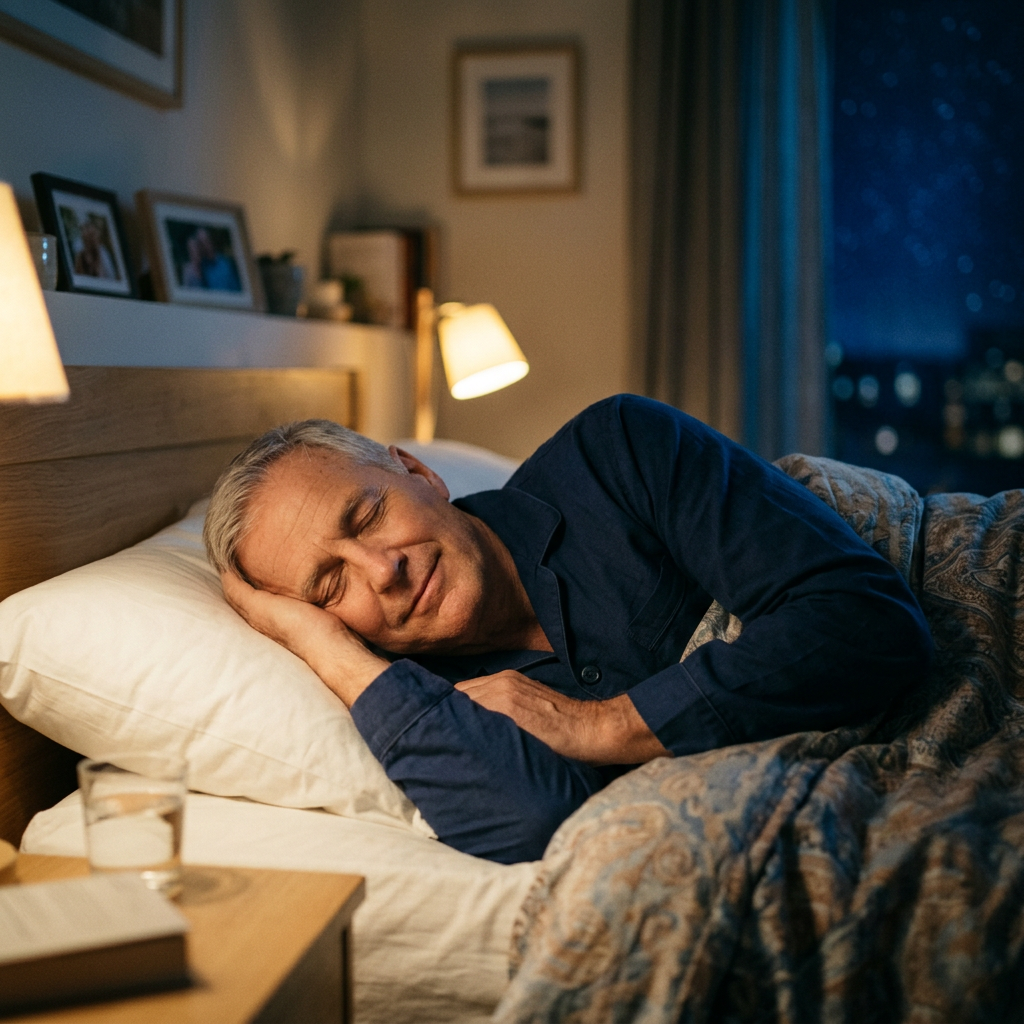
By Margaret Holloway | Updated April 2026 | ~14 min read Health & Aging | Sleep Science | Practical Wellness
The Bottom Line — Read This First
If you’re over 60 and sleeping badly, you are not imagining it. You are not weaker than you used to be. You are not failing at something that should be simple.
Your brain has physically changed in ways that make the sleep you had at 35 biologically harder to achieve at 65. That is not a character flaw. It is neuroscience.
But here’s what the research also shows — and what most people over 60 have never been told clearly: poor sleep in later life is not inevitable. It is not simply what aging does to you. It is, in most cases, a set of solvable problems with specific, evidence-based solutions.
The five strategies in this article are drawn from peer-reviewed sleep research, from the work of sleep specialists at major academic medical centers, and from the practical experience of people who have genuinely turned their sleep around after years of struggling.
None of them involve sleeping pills. None of them require expensive equipment. And none of them will work if you try all five simultaneously in the first week.
Read this carefully. Try one strategy at a time. Give each one four weeks before judging it.
The sleep you’re looking for is closer than you think.
Introduction: Why Sleep Changes as We Age — The Real Story
I want to spend real time on this before we get to solutions. Because understanding what’s actually happening in your brain at night is the foundation of everything else.
Most people — and, frankly, many physicians — explain poor sleep in older adults with a shrug and a phrase: “It’s just part of aging.” That explanation is not wrong. But it’s incomplete in ways that matter enormously for treatment.
Yes, sleep changes with age. The changes are real, well-documented, and begin earlier than most people realize — often in the mid-40s, accelerating through the 50s and 60s.
But “changes with age” is not the same as “is permanently broken.” And understanding specifically what changes, and why, is what makes targeted intervention possible.
What the Aging Brain Actually Does at Night
Sleep is not a single state. It’s a cycle of distinct stages — light sleep, deep sleep, and REM (rapid eye movement) sleep — that repeat four to six times across a healthy night. Each stage serves different biological functions. Deep sleep (called slow-wave sleep) is when the body repairs tissue, consolidates memories, and — critically — when the brain flushes out metabolic waste products through a system called the glymphatic pathway. REM sleep is when emotional processing happens and creative connections are formed.
In young adults, deep sleep comprises roughly 20 to 25 percent of total sleep time. By the mid-60s, that figure typically drops to 5 to 10 percent. By the mid-70s, some people have almost none.
This is not primarily about willpower, stress, or lifestyle choices. The neurons in the prefrontal cortex that generate slow-wave sleep — the part of the brain responsible for deep sleep — decline in number and activity as we age. This is structural. It is happening in virtually every aging brain.
Additionally, the suprachiasmatic nucleus — the small region in the hypothalamus that serves as the brain’s master clock — becomes less reliable with age. Its signals to the rest of the body about when to sleep and when to wake become weaker and less precise. This is why many older adults find themselves sleepy earlier in the evening and awake earlier in the morning — a phenomenon called advanced sleep phase syndrome.
Melatonin production — the hormone that signals darkness and sleep readiness — declines significantly with age, partly because the cells that produce it diminish and partly because the aging lens of the eye transmits less blue-spectrum light during the day, which in turn reduces the melatonin surge at night.
And then there are the sleep disorders that become more prevalent with age: sleep apnea (which often goes undiagnosed for years), restless leg syndrome, and periodic limb movement disorder — all of which fragment sleep without the person always being fully aware of why.
Why This Understanding Matters
Here’s why I’ve spent this much time on the biology before the solutions.
If you believe that bad sleep is simply what aging does to you — full stop — you’ll approach solutions with low expectations and low persistence. You’ll try something for a week, not see dramatic results, and conclude that nothing works.
If you understand that poor sleep in older adults is the result of specific, identifiable changes — some of which are genuinely fixed by structural decline, and some of which are highly responsive to behavioral and environmental intervention — you approach the same solutions differently. With targeted intention. With the right timeline for evaluation. With realistic expectations about which problems can be fully solved and which can be significantly improved even if not completely eliminated.
The five strategies below address different components of the aging sleep problem. None of them is a cure for structural neuronal decline. All of them can meaningfully improve sleep quality for most people over 60 who haven’t yet applied them systematically.

Strategy One: Anchor Your Circadian Rhythm With Light
Of all the strategies in this article, this is the one that has the strongest evidence base and the most consistent results across the widest range of people. It is also the most underused, because it sounds too simple to be as powerful as it is.
Your circadian rhythm — the roughly 24-hour biological clock that regulates when you feel sleepy and when you feel alert — is primarily set by light. Specifically, by the pattern of light exposure throughout the day.
In younger adults, this system is robust and relatively forgiving. In older adults, it becomes sensitive to disruption in ways that directly affect sleep quality.
The Morning Light Intervention
The single most evidence-supported behavioral intervention for sleep in older adults is consistent morning light exposure.
Here’s what the research at Harvard Medical School, Stanford Sleep Medicine Center, and multiple international research groups consistently shows: exposure to bright natural light within 30 to 60 minutes of waking — for 20 to 30 minutes, ideally outdoors — produces measurable improvements in sleep onset time, sleep duration, and sleep quality in adults over 60.
The mechanism is well understood. Morning light hits specialized cells in the retina called intrinsically photosensitive retinal ganglion cells, which send direct signals to the suprachiasmatic nucleus. This signal sets the biological clock for the day and triggers a cascade of hormonal events — including a predictable melatonin surge approximately 14 to 16 hours later.
In practical terms: if you expose yourself to bright morning light at 7am, your brain is primed to produce melatonin — and to feel genuinely sleepy — around 9 to 11pm. This isn’t a theory. It’s a measurable, reproducible hormonal response.
The challenge for older adults is twofold. First, many older adults spend significantly more time indoors than younger adults — reducing the quality and quantity of morning light exposure. Second, the aging eye’s lens becomes less transparent over time, transmitting less light to the retina, which reduces the strength of the circadian signal even when outdoor exposure occurs.
How to Implement This
Get outside within an hour of waking. Every morning. For at least 20 minutes.
Not through a window — glass filters out the UV and near-UV wavelengths that are most effective for circadian signaling. Outside, in natural daylight. Even on overcast days, outdoor light is typically 10 to 50 times brighter than indoor artificial light.
If outdoor exposure is genuinely not possible — due to weather, mobility, or living situation — a light therapy box that produces 10,000 lux of full-spectrum light is a well-supported alternative. Use it at eye level, within two to three feet, for 20 to 30 minutes while eating breakfast or reading.
The evening counterpart is equally important: minimize bright light exposure in the two hours before bed. Use warm-toned, dimmer lighting. Switch devices to night mode. If you use your phone in bed, the blue light emission is reducing the melatonin surge that your morning light exposure worked to build.
This one strategy — morning light, evening darkness — has produced clinically significant improvements in sleep quality in multiple randomized controlled trials of adults over 60. The study populations ranged from community-dwelling healthy older adults to patients in memory care facilities. The results were consistent across all of them.
Strategy Two: The Thermal Regulation Window
Most people know that a cooler bedroom is associated with better sleep. Fewer people know why — and understanding why reveals a more powerful and precisely targeted application of the same principle.
The Temperature-Sleep Connection
Sleep onset is not triggered primarily by darkness or by tiredness. It’s triggered by a drop in core body temperature.
In the hour or two before natural sleep, your body begins radiating heat from your hands, feet, and face — a process called peripheral vasodilation — which causes core body temperature to drop by approximately one to two degrees Fahrenheit. This temperature drop is not a consequence of sleep. It is a trigger for sleep. It’s what signals the brain that conditions are right to begin the sleep process.
In older adults, this thermoregulatory mechanism becomes less efficient. The peripheral vasodilation is less pronounced. The core temperature drop is smaller and slower. The sleep-onset signal is weaker.
This is one of the mechanisms behind the common experience of lying in bed for 30, 45, even 60 minutes before sleep arrives — not because the mind is racing, but because the body’s temperature hasn’t dropped far enough to trigger sleep.
How to Use This Strategically
First, the bedroom temperature. Research from the Netherlands Institute for Neuroscience and corroborated by multiple subsequent studies identifies a bedroom temperature between 65 and 68 degrees Fahrenheit as optimal for sleep in most adults. Slightly lower for some people, rarely lower than 60 or higher than 70.
For older adults specifically, research suggests that slightly warmer room temperatures — toward the upper end of this range — combined with lighter bedding produces better results than the very cool rooms often recommended for younger adults. This is because older adults’ peripheral circulation is less efficient, and a very cool room can cause uncomfortable cold extremities that paradoxically disrupt sleep.
Second, the warm bath or shower protocol. This sounds counterintuitive given what I just described — why take a warm bath to cool down? But the mechanism is precise and consistently effective.
A warm bath or shower (around 104 to 108 degrees Fahrenheit) taken 60 to 90 minutes before bedtime causes aggressive peripheral vasodilation — the body pushes blood toward the skin to cool itself. When you emerge from the bath, the heat dissipates rapidly through the skin surface, causing a faster and more pronounced core temperature drop than would occur naturally.
A 2019 meta-analysis published in the journal Sleep Medicine Reviews analyzed 17 studies on this “warm bath before bed” protocol and found that it reduced sleep onset time by an average of 10 minutes and improved overall sleep quality — measured by both subjective report and actigraphy — across all age groups, with the largest effects in adults over 60.
Ten minutes less time lying awake before sleep, repeated every night, is 60 hours per year of lying in bed not sleeping that you reclaim.

Strategy Three: Restructure Your Sleep Rather Than Lengthening It
This is the strategy that feels most counterintuitive when I first describe it to people. And it’s often the one that produces the most significant results.
It’s called sleep consolidation, and it’s the behavioral foundation of Cognitive Behavioral Therapy for Insomnia — CBT-I — which has more evidence supporting it than any pharmacological sleep treatment currently available.
The Fundamental Problem With How Most People Try to Fix Sleep
When sleep becomes poor, the instinctive response is to spend more time in bed. Go to bed earlier. Stay in bed later. Rest more to compensate for the poor quality.
This instinct is wrong. And it’s wrong in a way that makes the problem worse.
Spending more time in bed than your body can fill with sleep creates a pattern called sleep fragmentation — the scattered, shallow, frequently interrupted sleep that many older adults experience. By spreading a limited sleep capacity across too many hours in bed, you dilute whatever sleep drive you have and reinforce the pattern of lying awake.
The counterintuitive solution is to temporarily restrict the time you spend in bed to roughly match your current actual sleep time — then gradually extend it as sleep quality improves.
How Sleep Restriction Works in Practice
This protocol should ideally be supervised by a sleep specialist or implemented through a structured CBT-I program. I’m describing it here in overview because understanding the principle is valuable even if the full implementation requires guidance.
If you’re spending eight hours in bed but sleeping only five, the initial prescription might be a six-hour sleep window — a fixed bedtime and wake time that you maintain regardless of how tired you feel. This is uncomfortable for the first week or two. Sleep drive accumulates. When you do sleep within that window, you sleep more efficiently.
Over subsequent weeks, as sleep efficiency within the window improves, the window is gradually extended — typically by 15 minutes per week.
The result, for most people who complete the protocol, is not fewer total hours of sleep. It’s more consolidated, deeper sleep within a reasonable timeframe. The deep sleep percentage increases. The time lying awake decreases.
A 2022 meta-analysis in the Lancet found that CBT-I produced clinically significant improvements in sleep onset insomnia, sleep maintenance insomnia, and total sleep time in adults over 60 — with results that were superior to sleeping medication at 12-month follow-up, and without the side effects that sleep medications carry for older adults.
The One Non-Negotiable: A Fixed Wake Time
Even if you don’t implement full sleep restriction, the single element of this approach that produces the most benefit on its own is a fixed wake time.
Wake at the same time every day. Not just weekdays. Every day. Regardless of what time you went to bed or how the night went.
The fixed wake time is the anchor that regulates your circadian rhythm more powerfully than almost any other single behavioral change. Combined with morning light exposure at the same time each day, it creates a biological rhythm that the aging circadian system — which has become less robust — can reliably follow.
Strategy Four: Reframe Your Relationship With Waking at Night
This strategy is different from the others. It’s not primarily physical. It’s psychological. And for many people, it’s the one that creates the biggest immediate shift — not in the number of times they wake at night, but in the damage those wakings do.
The Catastrophizing Cycle
Here is a pattern I hear described constantly by older adults struggling with sleep.
You wake at 3am. You look at the clock. You calculate how many hours you’ve slept and how many hours remain before you need to get up. The numbers don’t look good. You begin to worry about how tomorrow will feel. The worry activates your sympathetic nervous system — the stress response. Your heart rate increases slightly. Your mind becomes more alert. Sleep recedes. Now you’re not just awake — you’re awake and anxious, and the anxiety makes sleep less accessible.
The waking itself, in many cases, would have resolved naturally within a few minutes. The catastrophizing about the waking turns a brief arousal into a 90-minute excursion into rumination.
This cycle is extremely common in older adults, partially because the normal, age-related increase in nighttime wakings has been framed — by culture, by well-meaning physicians, by the person’s own experience — as abnormal and pathological.
Here’s the reframe that sleep research supports.
Waking two to four times per night is biologically normal across the human lifespan. Historical records — including detailed diaries from the pre-industrial era — show that people commonly experienced “bimodal sleep”: sleeping for four hours, being awake for one to two hours, then sleeping for another three to four hours. The idea that healthy sleep is a continuous eight-hour block is partly a modern, post-industrial construct.
The physiological reality is that aging naturally increases night wakings. A person who wakes three times a night at 68 is not experiencing a sleep disorder. They are experiencing a normal feature of the aging sleep architecture.
What matters is not whether you wake at night. It’s what happens when you do.
The Practical Application
When you wake at night, resist the impulse to check the clock. Clock-checking triggers the calculation-and-catastrophizing cycle. Turn your clock away from the bed. Remove your phone from arm’s reach.
If you wake and your mind begins to activate, practice what sleep researchers call “cognitive defusion” — observing thoughts rather than engaging with them. The thought “I’m going to be exhausted tomorrow” does not require a response. It can be noticed, labeled (“there’s the worry thought”), and allowed to pass without amplification.
If you’re awake and relaxed — genuinely not distressed — staying in bed in quiet rest is fine. Quiet rest, even without sleep, is restorative. Your body is not suffering because you’re not sleeping every minute between 10pm and 6am.
If you’re awake and distressed, get up. Go to a dim, quiet room. Read something gentle. Return to bed when you feel sleepy. This is counterintuitive but prevents the bed from becoming associated with wakefulness and anxiety — an association that, once formed, is genuinely sleep-disruptive.

Strategy Five: Address the Specific Medical Contributors
Everything I’ve described so far is behavioral and environmental. But for a significant proportion of older adults, the largest contributor to poor sleep is not behavioral. It’s medical. And no behavioral intervention fully compensates for an unaddressed medical cause.
The two conditions I want to highlight are responsible for a disproportionate share of sleep problems in adults over 60 — and both are dramatically underdiagnosed.
Sleep Apnea: The Silent Wrecker
Sleep apnea — the repeated partial or complete collapse of the airway during sleep, causing brief arousals that fragment sleep without the person always being aware — affects an estimated 30 to 80 percent of adults over 65, depending on the diagnostic criteria used.
Most people with sleep apnea don’t know they have it. They know they sleep poorly. They know they’re tired during the day. They may know they snore. They don’t know that their airway is collapsing dozens or hundreds of times per night, that each collapse causes a micro-arousal that prevents them from reaching or sustaining deep sleep, and that this cycle is contributing to elevated cardiovascular risk, impaired cognitive function, and accelerated biological aging.
If you snore regularly, if your partner has observed you gasping or stopping breathing during sleep, if you feel unrefreshed after what should be an adequate night’s sleep, if you experience excessive daytime sleepiness despite spending enough time in bed — these are indications for a sleep study.
Modern home sleep testing has made this evaluation dramatically more accessible than it was ten years ago. The treatment — CPAP therapy for most people — has similarly improved in comfort and effectiveness. People who successfully treat moderate to severe sleep apnea often describe their post-treatment sleep as transformationally better — like having a new brain.
Medication Side Effects and Interactions
The average adult over 65 in the United States takes four to five prescription medications. Several of the most commonly prescribed drug classes have significant sleep-disrupting effects that are frequently not discussed with patients.
Beta-blockers — commonly prescribed for blood pressure and heart conditions — suppress melatonin production, often dramatically. If you started a beta-blocker around the time your sleep got worse, the connection is likely not coincidental.
Diuretics — also common in cardiovascular treatment — increase nighttime urination, fragmenting sleep mechanically. The timing of diuretics can often be adjusted to reduce this effect.
Corticosteroids, certain antidepressants, decongestants, and some medications for Parkinson’s disease all have documented sleep-disrupting effects.
A medication review specifically focused on sleep effects — conducted with your physician or a clinical pharmacist — is worth requesting if you take multiple medications and sleep poorly. The question to ask is simple: “Are any of my current medications known to affect sleep quality, and if so, are there alternatives or timing adjustments that might help?”
This conversation is often not initiated by physicians. You may need to initiate it yourself. It is worth initiating.
Chronic Pain as a Sleep Disruptor
Pain and poor sleep exist in a bidirectional relationship that is particularly consequential for older adults. Pain disrupts sleep. Sleep deprivation lowers pain tolerance and increases pain perception. The result is a reinforcing cycle that gets worse without targeted intervention.
If pain is a significant contributor to your sleep disruption, treating the pain and treating the sleep simultaneously produces better results than addressing either in isolation. This is worth discussing explicitly with your healthcare provider rather than treating each symptom separately.

A Note on Sleep Medication
I’ve deliberately not made sleep medication a strategy in this article. I want to explain why, briefly, because it’s a decision some readers may question.
Sleep medications — from benzodiazepines to the newer “Z-drugs” like zolpidem to over-the-counter antihistamine-based sleep aids — are among the most commonly prescribed and purchased substances for older adults.
The evidence base for their long-term use in older adults is, to put it gently, concerning.
Benzodiazepines and Z-drugs are associated with increased fall risk (falls are the leading cause of injury-related death in adults over 65), impaired cognitive function, dependency, and — importantly — they do not produce natural sleep architecture. They sedate. They reduce the time to sleep onset. But they do not produce the slow-wave deep sleep that the aging brain most needs. In many cases they actually suppress slow-wave sleep.
Antihistamine-based sleep aids — diphenhydramine, found in Benadryl and many OTC sleep products — have significant anticholinergic effects that are particularly problematic in older adults, including increased risk of cognitive impairment.
This doesn’t mean no older adult should ever use sleep medication. It means that medication should be a last resort after behavioral approaches have been genuinely tried, should be short-term rather than ongoing, and should be selected and supervised by a physician who is specifically aware of the risks in older populations.
The strategies in this article have more evidence supporting them — for older adults specifically — than any currently available sleep medication. They take longer to show results. They require consistency. They don’t work in a night. But they improve sleep in ways that address the actual problem rather than masking it.
Summary and Key Takeaways
Poor sleep after 60 is common. It is not inevitable, and it is not untreatable.
The aging brain undergoes real, structural changes that affect sleep — reduced slow-wave sleep, weakened circadian signaling, decreased melatonin production. Understanding these changes makes it possible to address them specifically rather than hoping that general sleep hygiene will compensate.
The five strategies covered in this article — morning light anchoring, thermal regulation, sleep consolidation, reframing nighttime waking, and addressing medical contributors — each target different components of the aging sleep problem. Used systematically and with appropriate patience, they produce measurably better sleep for most older adults.
The timeline is not a week. It’s four to eight weeks of consistent application before the full benefit of most of these strategies is apparent. Give each strategy genuine time before concluding it hasn’t worked.
10 Science-Backed Tips for Better Sleep After 60
1. Get outside within an hour of waking, every morning, for 20 minutes. This is the single most evidence-supported behavioral sleep intervention for older adults. Morning light sets the circadian clock. Do it even on cloudy days.
2. Minimize bright and blue light in the two hours before bed. The morning light builds your melatonin surge. Evening light destroys it. Use warm-toned, dim lighting after 8pm.
3. Take a warm bath or shower 60 to 90 minutes before bed. The post-bath cooling effect accelerates sleep onset. The evidence is consistent across multiple studies and particularly strong in adults over 60.
4. Keep your bedroom between 65 and 68 degrees Fahrenheit. Core temperature drop triggers sleep. A cool room facilitates the drop. Slightly warmer within this range for older adults whose circulation is less efficient.
5. Fix your wake time and hold it every day. Wake at the same time every morning regardless of when you went to bed or how the night went. This is the single most powerful behavioral anchor for the aging circadian system.
6. Stop checking the clock when you wake at night. Turn the clock away from the bed. Clock-checking triggers the catastrophizing cycle that turns a brief arousal into a long wakeful period.
7. Accept that waking at night is normal. Two to four nighttime wakings is biologically normal in older adults. What matters is your response to them, not their existence.
8. Ask your doctor about your medications’ sleep effects. Beta-blockers, diuretics, antihistamines, and corticosteroids all have documented sleep-disrupting properties. A medication review focused on sleep effects may reveal an easy fix.
9. Get evaluated for sleep apnea if you snore or feel consistently unrefreshed. Undiagnosed sleep apnea is one of the most common and most treatable contributors to poor sleep in older adults. Modern testing is simple and home-based.
10. Try CBT-I before medication. Cognitive Behavioral Therapy for Insomnia has more evidence supporting it than any sleep medication for older adults. Your primary care physician can refer you, or look for structured digital CBT-I programs, which have been validated in multiple trials.
This article is for informational purposes only and does not constitute medical advice. Sleep disorders can have serious health consequences. If you are experiencing significant sleep disruption, please consult a qualified healthcare provider. For sleep apnea evaluation, ask your doctor about a referral to a sleep medicine specialist.
Tags: Sleep After 60 | Aging and Sleep | How to Sleep Better as You Age | Sleep Problems Seniors | Science of Sleep | Insomnia in Older Adults | CBT-I | Sleep Apnea Seniors
It’s never too late to learn, grow, and discover new possibilities.
Explore the books of Han Jong-Woo, where artificial intelligence, lifelong learning, personal growth, and meaningful living come together to inspire your next chapter.
Whether you’re curious about AI, seeking purpose, or simply looking for fresh inspiration, you’ll find books designed to encourage, empower, and enrich your life.
▶ Visit Han Jong-Woo’s Amazon Auhttps://www.amazon.com/s?i=digital-text&rh=p_27%3AJongWoo%2BHan&s=relevancerank&text=JongWoo+Han&ref=dp_byline_sr_ebooks_1thor Page and discover all of his books today.
Leave a Reply