By Jong-Woo Han | October 2026
SummitSelect.org | AI & the Future of Work | Human Skills | Life After 60
The Answer First — Before the Debate Begins
Let me tell you what I’ve concluded after three years of using AI tools seriously and watching the landscape shift faster than almost anyone predicted.
AI will replace far more jobs than most optimistic commentators are willing to say. The disruption is real and it’s accelerating. Anyone who tells you otherwise is either selling something or not paying close attention.
But there are specific things — not vague categories, not comforting abstractions, but specific human capacities — that AI cannot replicate. Not because the technology hasn’t gotten there yet. Because of what these capacities fundamentally are and what they require to exist.
The jobs that will remain most human are not the jobs that require the most technical knowledge. Technical knowledge can be learned, encoded, and generated by AI at scale. The jobs that stay human are the ones built on something else entirely: the specific weight that comes from a person who has actually lived through something, who carries genuine stakes in the outcome, and who exists in a body that has felt loss and joy and the passage of real time.
That’s not mysticism. That’s a practical observation about what people actually need from other people — and what no amount of computational sophistication can substitute for.
Introduction: Why I Started Thinking About This Differently
I’ll be honest about what shifted my thinking.
About a year ago, I asked Claude — the AI tool I use most — to help me write a condolence letter to a family member of a reader who had died. The reader had written to me several times. I’d corresponded with him for over a year. His son had emailed to let me know.
The AI produced a perfectly structured, appropriately toned, emotionally calibrated letter. It was, technically, a good letter.
I didn’t use it.
I sat down and wrote the letter myself, badly, with some crossed-out sentences and an imperfect structure — because that letter needed to come from me. Not from a well-trained language model that had processed millions of examples of condolence letters. From a person who had actually known this man’s voice through his messages, who felt the specific weight of his absence, who was writing as an act of genuine mourning rather than an act of communication optimization.
That experience crystallized something I’d been circling for months. The question of what AI can never replace isn’t primarily a technical question. It’s a question about what human beings need from other human beings — and why.

What AI Is Actually Replacing — Honestly
Before talking about what AI can’t replace, I want to be clear-eyed about what it can and is replacing.
AI is replacing information retrieval. Any job that primarily involves looking things up, categorizing what’s found, and delivering it to someone who needs it — AI does this faster, cheaper, and at scale.
AI is replacing pattern recognition in large datasets. Medical imaging analysis, financial fraud detection, legal document review, quality control in manufacturing — AI identifies patterns in data with accuracy that exceeds human performance in many specific contexts.
AI is replacing first-draft production of structured content. Reports, summaries, standard correspondence, data analysis write-ups, code documentation — if it’s formulaic, AI can generate a usable first draft almost instantly.
AI is replacing routine customer service and administrative interaction. Answering frequently asked questions, processing standard requests, routing inquiries, scheduling — the kind of interaction that follows predictable patterns.
AI is replacing some diagnostic support roles. Not replacing physicians, but replacing the parts of clinical work that involve identifying known patterns in known data — which turns out to be a substantial portion of some specialties.
I’m not saying this to be alarming. I’m saying it because clear-eyed assessment of what AI is replacing makes it possible to think clearly about what it isn’t — and can’t.
The Capacities AI Cannot Replicate
1. Being a Witness
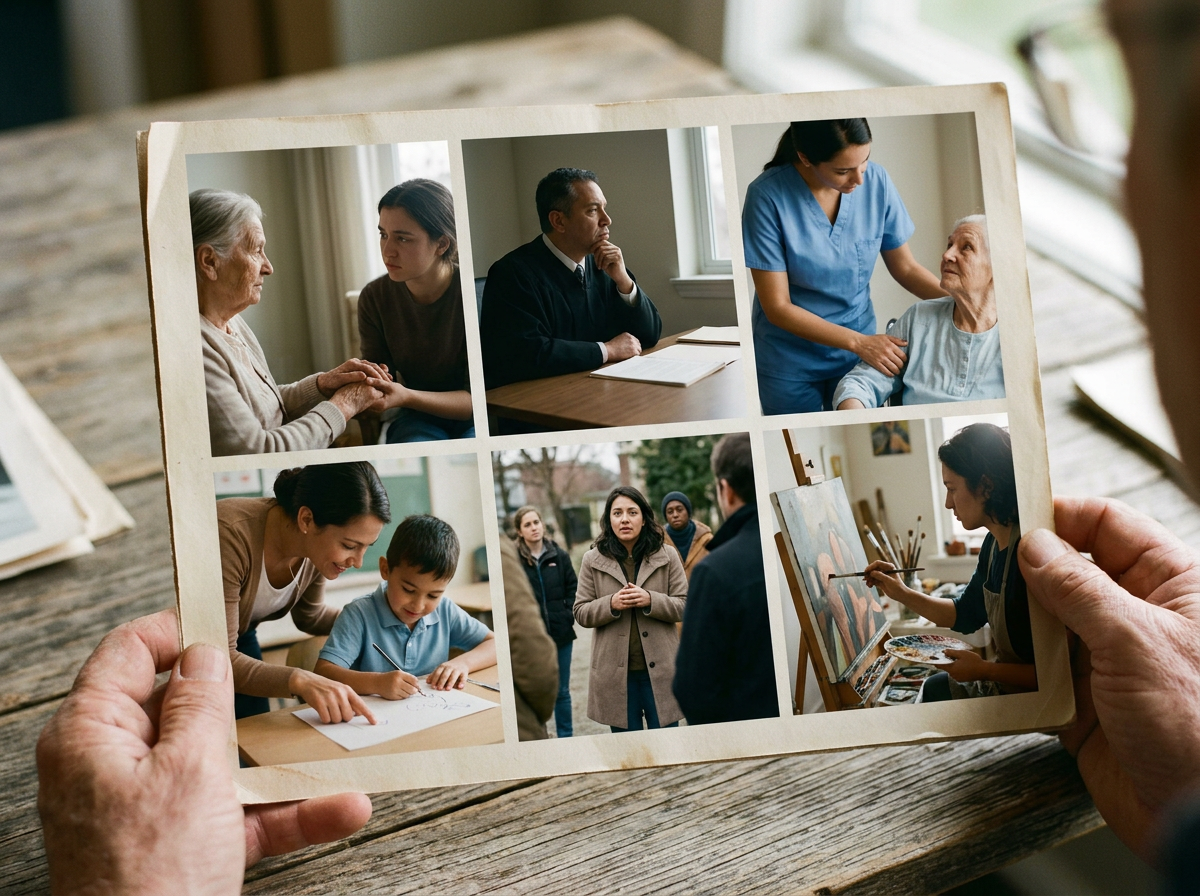
There is something specific that happens when another person is genuinely present with you in a difficult moment. Not processing your situation, not analyzing your options, not generating empathetic responses calibrated to your expressed emotional state — but being there. Being moved by what is moving. Having their own experience changed by being with yours.
This is what happens when a chaplain sits with a dying patient. When a therapist’s eyes fill with tears at something a client says. When a teacher stays after class not to provide additional instruction but just to be present with a student who’s struggling.
AI cannot be a witness because it cannot be changed by what you tell it. Your story doesn’t alter the AI’s own experience because the AI doesn’t have one. It processes, responds, and generates — but it doesn’t witness.
The jobs built on this capacity — chaplaincy, grief counseling, certain kinds of social work, hospice care, certain kinds of teaching — are not jobs built on information. They’re jobs built on presence. And presence requires someone who actually shows up.
2. Making Consequential Decisions Under Genuine Uncertainty — With Real Stakes
AI can model uncertainty. It can present probabilities, weight factors, simulate scenarios. What it cannot do is bear the weight of a wrong decision.
A physician deciding whether to recommend surgery on a 78-year-old patient with significant comorbidities is not primarily doing an information processing task. She’s making a judgment under genuine uncertainty, with a specific person in front of her whose particular history and particular fear and particular values matter — and she’s bearing the moral weight of that judgment in a way that affects how she sleeps that night.
AI can support that decision. It can provide relevant literature, flag considerations, surface relevant patterns from similar cases. But the decision needs to be made by someone who will carry it. Who has professional accountability. Who can be changed by getting it wrong.
The jobs that require this kind of decision-making — medicine, law, certain kinds of leadership, certain kinds of policy work — are not primarily at risk from AI replacement. They’re at risk from AI augmentation that removes the weight from decisions that should have weight. That’s a different and in some ways more serious problem than replacement.
3. Moral Courage — Acting Despite Cost
AI has no career to risk. No family to support. No reputation to lose. No fear to overcome.
Moral courage — the specific act of doing what you believe is right when doing so is genuinely costly to you — requires all of those things as context. It requires a person who has something at stake and chooses the right thing anyway.
The nurse who speaks up to a supervising physician about a medication error she believes is about to happen. The accountant who tells a client something they don’t want to hear about their financial situation. The teacher who advocates for a student against institutional pressure. The journalist who publishes a story that will have consequences for the publication and for themselves personally.
These acts cannot be AI-generated because they require a person who can actually be harmed by the choice. The courage is meaningful only because the stakes are real. And the stakes are real only to a being with a life that can be affected.
4. Physical Presence and Touch in Care
Some work is fundamentally about bodies. A physical therapist who knows from the resistance in someone’s shoulder exactly how to adjust the movement. A massage therapist whose hands feel what an assessment form can’t capture. A pediatric nurse who knows when to hold a child’s hand and when to give them space. An emergency responder who physically carries someone out of danger.
AI can guide robots. Robots can perform some physical tasks. But the embodied intelligence of someone who has spent years learning how human bodies work — who adapts in real time to what they’re feeling rather than what they’re measuring — is not the same thing.
This isn’t about the manual dexterity of robots, which will improve. It’s about the combination of physical presence, embodied learning, and the relational context of being touched by another human being that is itself part of what makes certain care therapeutic. People recover differently when they’re touched by a person than when they’re touched by a machine, even when the physical manipulation is identical. That difference matters clinically and it matters humanly.

5. Teaching That Changes Who Someone Is
There’s a difference between instruction and education.
Instruction is the transmission of specific knowledge and skills. AI is increasingly excellent at instruction — patient, available at any hour, adaptable to learning pace, capable of explaining the same concept twenty different ways until one lands.
Education, in its deepest sense, is something different. It’s the process by which a person is changed — not just in what they know, but in who they are. Who they’re becoming. How they see the world.
This process doesn’t happen through information delivery. It happens in relationship. It happens when a teacher sees something in a student that the student hasn’t seen in themselves yet, and holds that vision long enough for the student to grow into it. It happens when a mentor’s belief in you before you’ve earned it gives you the psychological permission to try something you’d otherwise be too afraid to attempt.
AI can tell a student they’ve done good work. It cannot convince them that they matter. Those are different things.
The teachers, mentors, coaches, and guides whose work is fundamentally about the transformation of another person — not just the accumulation of their knowledge — are not at risk from AI in the ways that information-delivery roles are.
6. Leadership Under Genuine Adversity
Not management. Not coordination. Not project oversight. Leadership — the specific thing that happens when a group of people faces genuine uncertainty, real danger, or high-stakes failure, and someone among them orients them toward the path forward.
This requires a person who can be afraid and still appear capable. Who can absorb the group’s anxiety and return something like steadiness. Who has earned the trust that makes other people willing to follow — not through algorithmic optimization, but through the accumulated weight of having been reliable before.
AI can model optimal decision paths. It cannot lead human beings through moments that feel existentially uncertain. That requires a human presence that can be genuinely uncertain and genuinely steady at the same time — a paradox that only lived experience teaches.
7. Creative Work That Is Genuinely Personal
AI can generate creative content at scale. It can produce music, writing, visual art, and performance scripts that are technically accomplished, aesthetically coherent, and sometimes genuinely beautiful.
What AI cannot generate is work that comes from somewhere specific. Work that carries the weight of a particular person’s particular life. Work that could not have been made by anyone else because it comes from experiences that no one else has had.
The artist who makes work about her mother’s dementia. The novelist who writes about the specific weight of grief in the particular culture he grew up in. The musician who makes something from the particular loneliness of a specific kind of adolescence in a specific kind of place.
These works are valuable not only for their technical qualities — which AI can often approximate — but for the specific origin they carry. For the fact that another human being made them, and in making them, made something true about human experience that someone else can recognize.
The most important creative work will remain human not because AI lacks technical capability, but because the source of a work — who made it and from what lived reality — is itself part of what a work of art is.

What This Means for People Over 60
I write primarily for people who are in or approaching the second half of their professional lives. And I want to say something specific to that group.
The capacities I’ve described — presence, moral weight, embodied wisdom, transformative relationship, lived experience — are not things that develop quickly. They accumulate over decades of showing up, of being changed by experiences, of learning from mistakes that actually had consequences.
This means that the AI disruption hitting the labor market is not hitting all age groups equally. The early-career roles most at risk are the information-processing and pattern-recognition roles that used to be the reliable entry point into professional life. The mid-career roles at risk are the knowledge-work roles that involve synthesizing and applying information in predictable contexts.
The late-career and senior professional roles — the ones built on the capacities I’ve described — are actually increasingly differentiated from AI capability, not decreasingly.
This is not guaranteed protection. There are ways to hold a senior role that are primarily about information and institutional status, not about genuine human capacity — and those roles are not protected. But the genuine capacities that life experience builds are more valuable in a world of abundant AI than they were in a world of scarce information.
A retired physician who brings 35 years of clinical judgment, patient relationship experience, and the embodied knowledge of what it means to be sick and afraid — that person is not being replaced. They’re becoming more valuable as a check on AI-assisted diagnosis, as a patient advocate who can translate between algorithmic outputs and human situations, as a teacher of the capacities that can’t be learned from data.
The same pattern holds in counseling, in education, in law, in leadership, in the work of genuine care.
The Risk Worth Naming
There’s something worth saying clearly that most optimistic writing about AI and human work avoids.
The risk isn’t only that AI will replace human jobs. The risk is that we’ll let AI replace human roles in ways that hollow out the capacities themselves.
If we use AI to mediate all medical communication, we stop developing the physician who can sit with a patient through a terminal diagnosis. If we use AI to provide all emotional support to isolated older adults, we stop building the human systems that could actually provide that support. If we automate all the entry-level work that used to be where moral courage was first practiced in small situations, we stop growing the people who can exercise it in large ones.
The human capacities I’ve described are not static assets. They’re cultivated through practice. They require situations in which they’re called upon. If we design those situations out of existence in the name of efficiency, we don’t just change who does the work — we change who we are.
This is the larger stakes of the AI-and-human-work conversation. It’s not only about employment. It’s about what kind of people we’re becoming.

Frequently Asked Questions
Which jobs are safest from AI replacement in the next decade?
The most protected roles are those built on embodied presence, genuine relationship, moral accountability, and lived experience — chaplaincy, grief counseling, hospice care, certain kinds of teaching, physical therapy, certain leadership roles, and creative work that carries a specific personal origin. Roles primarily built on information processing, pattern recognition in data, or production of formulaic content are significantly more exposed. Most professional roles will be affected by AI augmentation — the question is whether the human elements remain central or become peripheral.
Is emotional intelligence something AI can develop over time?
AI can simulate emotional intelligence — recognizing emotional states, generating contextually appropriate emotional responses, maintaining conversational coherence across emotional topics. What it cannot develop is the genuine emotional experience that underlies authentic human connection: being actually moved by someone’s suffering, having your own perspective changed by an encounter, carrying the weight of a relationship over time. These require a being with genuine emotional life, not simulated emotional responsiveness.
If AI can do most of my job, how do I make myself more valuable?
The practical question is which elements of your current role are primarily about information and pattern recognition versus which elements require human presence, relationship, and judgment with real stakes. The former is where AI displaces; the latter is where it doesn’t. The strategic response is to identify and cultivate the genuinely human elements of your work — developing the relationship skills, the judgment under uncertainty, the moral clarity, the embodied expertise that AI cannot replicate — while using AI to handle the information-processing elements more efficiently.
Are the jobs that AI can’t replace mostly low-paying care work?
This is a widespread and important misconception. The jobs built on irreplaceable human capacity span a very wide income range. Senior physicians, experienced lawyers, military leaders, experienced therapists, senior educators, established artists — these are not low-paying roles. The care work that AI can’t replace (hospice care, chaplaincy, physical therapy) is currently underpaid relative to its human importance, but that’s a policy and cultural failure rather than an inherent characteristic of human-essential work. The economic argument for investing in human capacity has, if anything, become stronger in an era of AI abundance.
Does being over 60 make me more or less valuable in an AI-dominated job market?
In general, more valuable — with important nuances. The capacities that AI cannot replicate (embodied wisdom, earned trust, the weight of lived experience, the judgment that comes from having been wrong and recovered) tend to develop over time rather than diminishing with it. The nuance: this applies to roles that are genuinely built on these capacities, not to roles where age discrimination is most active or to roles primarily built on knowledge that AI can encode. The strategic insight for people over 60 is to focus their energy on the professional contexts where accumulated human experience is the primary value, not the contexts where younger candidates with AI fluency have the clearest competitive advantage.
Will there still be meaningful work for humans in 20 years?
Yes — but not automatically, and not without deliberate choices about what we want the future of work to include. The genuinely human capacities I’ve described will remain relevant because people will continue to need other people for the things that only people provide. The uncertainty is whether we’ll design our institutions and our economy to recognize and value that need — or whether we’ll let the pursuit of efficiency crowd out the spaces where human presence is irreplaceable. That’s a choice we’re making now, gradually, through thousands of institutional decisions that rarely announce themselves as choices about human values.
Summary
The jobs AI cannot replace are built on capacities that require a being with genuine stakes, real experience, an actual life that can be changed by encounters with other lives.
Being a witness to another person’s suffering — not processing it, but being genuinely present with it. Making consequential decisions that have moral weight and that the decision-maker will carry. Acting with moral courage when it’s genuinely costly. Providing physical care and touch that is itself part of what makes care healing. Teaching in ways that transform who someone is, not just what they know. Leading people through genuine adversity that requires human presence to navigate. Making creative work that could only have come from this particular person’s particular life.
These are not yesterday’s jobs protected by sentiment. They’re the jobs that matter most to human flourishing — and they’re the jobs that AI’s increasing capability makes more, not less, clearly irreplaceable.
For people over 60: the capacities that AI cannot replicate are the ones that decades of living builds. You are not being left behind by this transition. You are, in the ways that matter most, increasingly differentiated from what AI can provide.
Key Tips
1. Identify which elements of your work are information-based versus relationship-based. AI displaces the former and amplifies the latter. Knowing the difference in your specific role is the starting point for positioning.
2. Develop the genuinely human elements deliberately. Presence, judgment under uncertainty, moral courage in small situations — these are practices that can be cultivated, not just traits you either have or don’t.
3. Use AI to handle what AI handles well — and invest the saved time in what only you can do. The human professional who uses AI for information processing and invests their freed capacity in genuine relationship and judgment will consistently outperform both the human who ignores AI and the AI that lacks human experience.
4. Resist the hollowing out of genuinely human roles. When AI is used to remove the human element from roles that exist specifically because they’re human — grief counseling mediated entirely by chatbot, medical communication handled entirely through AI interfaces — that’s a loss worth naming.
5. Value lived experience as a professional asset. In a world of abundant AI-generated information, the person who has actually been through something has an increasingly rare credential. The physician who has been a patient, the financial advisor who has navigated a financial crisis personally, the counselor who has experienced loss — these people offer something data cannot replicate.
6. Invest in the capacities your grandchildren will need. The children being raised now are entering a world where information fluency is table stakes and human capacity is the differentiator. What they need to cultivate is not AI fluency (which they’ll have) but the emotional, relational, and moral capacities that AI cannot generate.
7. Pay attention to what you need from other humans. The clearest signal of what AI cannot replace is what you personally seek out other people for. The doctor, not the app. The friend, not the chatbot. The mentor, not the FAQ. Your own needs point toward the irreplaceable.
Conclusion
The question of what AI can never replace is not primarily a technological question. It’s a question about what human beings are for — what we need from each other that no tool, however sophisticated, can provide.
The answer, when you look at it clearly, is not small. We need witnesses to our suffering. We need people who make decisions that carry moral weight and bear it. We need to be touched by hands that feel us. We need to be changed by teachers who see us before we’ve grown into what we’re becoming. We need leaders who can be afraid and show up anyway. We need art that comes from somewhere specific and true.
None of that is going away. The question is whether we’ll have the wisdom to design our institutions, our economy, and our cultural values around the recognition that these things matter — rather than letting the relentless logic of automation make the decision for us by default.
That’s the work worth doing. And it’s very much work that only humans can do.
SEO Information
SEO Title:
Jobs AI Can Never Replace: The Human Skills That Will Always Matter
Meta Description:
AI is transforming the workforce faster than anyone predicted — but some jobs remain irreplaceable. A 71-year-old author explains exactly which human capacities AI can never replicate and why they matter more now than ever.
Suggested URL Slug:
/jobs-ai-can-never-replace-human-skills
Primary Keyword:
jobs AI can never replace
Secondary Keywords:
human skills AI cannot replace, future of work AI, what jobs are safe from AI, AI and human work, irreplaceable human capacities, AI replacing jobs 2026, working after 60 AI era
Search Intent:
People searching this term want honest, specific analysis of which jobs and human capacities are genuinely protected from AI displacement — not reassurance or alarm, but clear thinking about what makes certain work irreducibly human and why it matters.
Suggested Featured Image Prompt:
Warm, editorial-style photograph of two human hands — one older, one younger — in a moment of genuine human connection, perhaps in a clinical or counseling setting. The hands communicate presence, care, and relationship that no digital tool can provide. Soft natural light. The image should feel intimate and real, not illustrative or symbolic. Warm amber tones, editorial photography, deeply human.
Suggested Image Alt Text:
Two human hands in a moment of genuine care and connection, representing the irreplaceable human capacities that AI cannot replace in meaningful work.
Jong-Woo Han is a 71-year-old author and founder of SummitSelect.org. His books — AI Made Simple for Seniors, AI for Meaningful Living After 60, The $1,000 AI Side Hustle, and AI and Your Health After 60 — are available on Amazon.
It’s never too late to learn, grow, and discover new possibilities.
Explore the books of Han Jong-Woo, where artificial intelligence, lifelong learning, personal growth, and meaningful living come together to inspire your next chapter.
Whether you’re curious about AI, seeking purpose, or simply looking for fresh inspiration, you’ll find books designed to encourage, empower, and enrich your life.
▶ Visit Han Jong-Woo’s Amazon Authohttps://www.amazon.com/s?i=digital-text&rh=p_27%3AJongWoo%2BHan&s=relevancerank&text=JongWoo+Han&ref=dp_byline_sr_ebooks_1r Page and discover all of his books today.
Leave a Reply