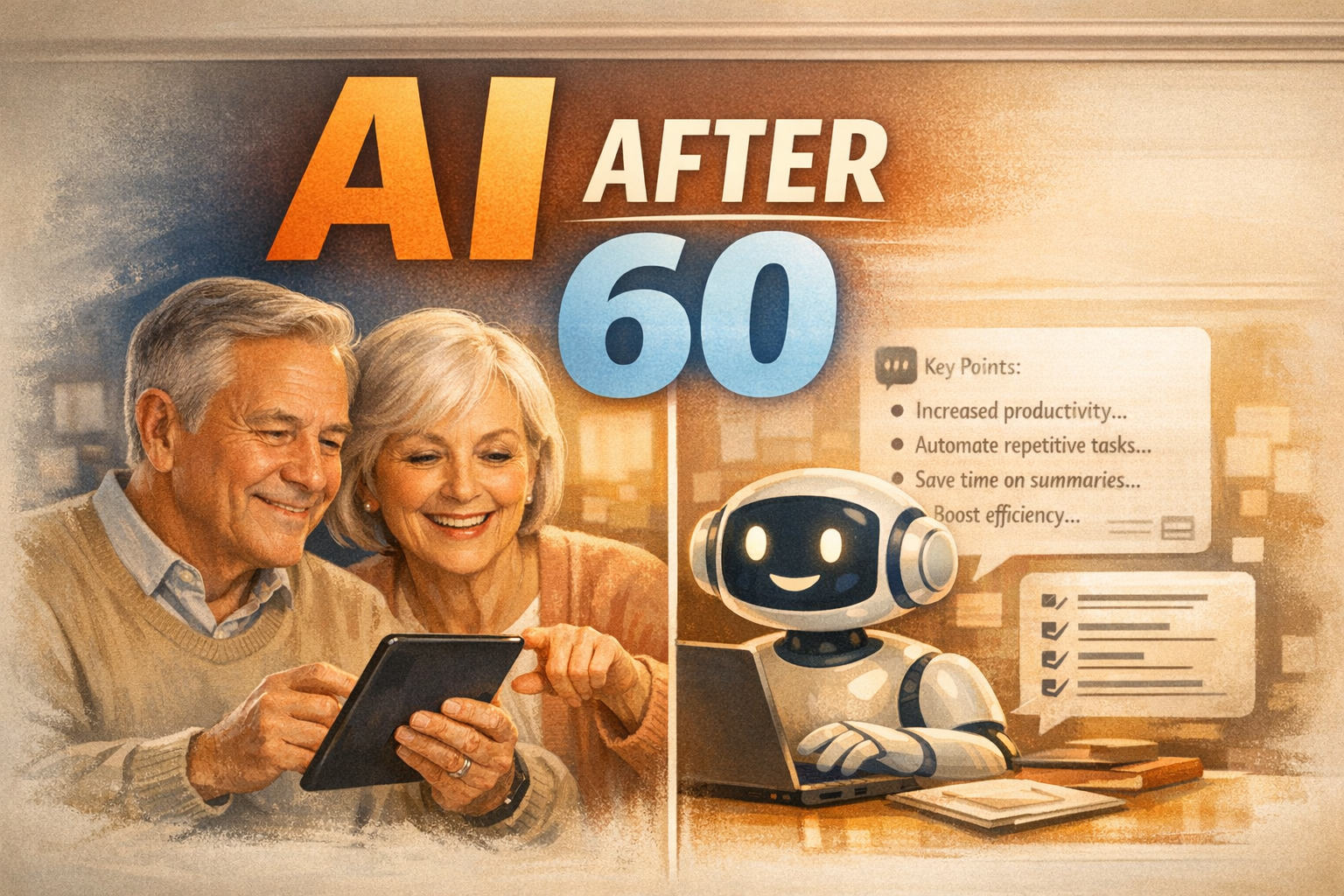
The conclusion, right up front
AI is not going to replace you, confuse you, or steal your identity.
What it is going to do — if you give it a chance — is make certain parts of life after 60 considerably easier. Managing health information. Staying in touch with family. Learning new things without having to ask anyone for help. Catching potential scams before they catch you.
The people most likely to benefit from AI are not twenty-five-year-old developers. They are people who have more time to think, deeper questions to ask, and real problems that need solving. That description fits a lot of people over sixty rather well.
This article is not about hype. It is about something practical: why this particular moment in technology actually matters for your life, and what you can do about it starting today.
Something has genuinely changed — and it happened fast
Most technology trends are overstated.
The metaverse. NFTs. Self-driving cars that were always “five years away.” We’ve all watched excited predictions fail to materialise, and it has made a lot of sensible people justifiably sceptical of anything described as revolutionary.
AI in 2025 is different. Not because of the hype around it — but because of one specific, verifiable thing: you can now hold a natural conversation with a computer and get genuinely useful answers.
That sounds modest. It isn’t.
For decades, getting information from a computer meant knowing the right search terms, clicking through links, evaluating sources, and piecing together an answer yourself. It required a certain kind of technical fluency that many people never felt fully comfortable with. If you ever felt slightly behind with technology — like everyone else understood something you didn’t quite grasp — that gap was real, and it was frustrating.
The new AI tools — ChatGPT, Claude, Google’s Gemini — change that equation. You can now describe what you need in plain, everyday English. “I have a doctor’s appointment next Tuesday and I want to understand what my cholesterol numbers mean before I go.” That sentence, typed into ChatGPT, will return a clear, organised explanation tailored precisely to what you asked.
No searching. No clicking. No wading through a dozen websites. Just a direct, readable answer.
For anyone who found old-style internet searches a chore, this is not a small shift. It is a fundamental one.
“A warm and realistic illustration of a man in his late 60s sitting in a comfortable armchair near a window, holding a tablet and reading something on the screen with a calm, engaged expression. Afternoon light coming through the curtains. A cup of tea on the side table. On the screen, a simple chat interface with a question about medication side effects and a clear, readable response. The overall mood is quiet confidence — this person has found something genuinely useful. Watercolor-style illustration, warm earthy tones, no technology fear.”

The six areas where AI makes the biggest difference after 60
Not everything about AI is relevant to everyone. But across six specific areas, the benefits for people in their sixties, seventies, and beyond are real, concrete, and available right now.
1. Health — understanding what your doctors are telling you
Healthcare after 60 gets complicated.
More medications. More specialist appointments. More test results with numbers and abbreviations that don’t explain themselves. After a particularly packed doctor’s visit, it is remarkably common to walk out the door feeling less informed than when you walked in — simply because there wasn’t enough time to process everything that was said.
AI handles this surprisingly well.
You can type — or even speak, using voice input — something like: “My doctor said my eGFR is 58 and mentioned stage 3 kidney disease. What does that actually mean, and what should I be asking at my next appointment?” Within seconds, you get a clear explanation of the eGFR scale, what stage 3 kidney disease involves, lifestyle changes that might help, and a list of specific questions to bring back to your physician.
This is not the same as replacing medical care. No sensible person suggests that. What it does is prepare you. An informed patient who arrives at an appointment with good questions gets far more out of that appointment than someone who nods along and hopes for the best.
The same applies to medications. Many people take several medications and have only a vague sense of what each one does. Ask an AI to explain your medication list — its purposes, potential interactions, and any foods or activities to be careful about — and you get information that should have been explained at the pharmacy but often wasn’t.
2. Staying independent at home
One of the deepest concerns for many people after 60 is maintaining independence. The fear of becoming a burden. The discomfort of needing to ask for help with things that used to be automatic.
AI tools are beginning to address this in quiet, practical ways.
Smart home voice assistants — Amazon’s Alexa, Google Home, Apple’s Siri — have been around for years. But they have become considerably more capable. Hands-free control of lights, thermostats, and door locks is now genuinely reliable. For anyone with arthritis, limited mobility, or vision difficulties, removing the physical friction from basic home management is not a luxury. It is meaningful independence.
Beyond the home, AI-powered reminders and health tracking are helping people manage chronic conditions without relying on family members to be the memory system. A simple AI reminder setup can ensure medication is taken on schedule, hydration goals are tracked, and upcoming appointments never slip.
There is also something to be said for the moment when you don’t have to call your daughter to ask how to do something on your phone. Being able to ask an AI — privately, without feeling like a burden, at any hour — preserves a kind of dignity that people rarely talk about but feel deeply.
3. Fighting loneliness and staying mentally sharp
Loneliness after retirement is one of the most underreported health issues of our time.
Studies from Harvard’s long-running study on aging, and from researchers at Brigham Young University, suggest that chronic loneliness carries health risks comparable to smoking fifteen cigarettes a day. Social isolation accelerates cognitive decline. It weakens the immune system. It contributes to depression in ways that are often mistaken for “just getting older.”
AI is not a replacement for human connection. That needs to be said plainly. But it can meaningfully reduce the texture of daily isolation.
An AI like Claude or ChatGPT can hold a conversation. It can engage with ideas, debate history, discuss books, play word games, and explain anything you want to understand. For someone living alone, or living in a community where daily intellectual engagement is limited, having a conversation partner available at any moment — one that never grows impatient, never makes you feel slow, and genuinely adapts to your interests — is not a trivial thing.
There is also strong evidence that continued learning protects cognitive health as we age. The brain that keeps encountering new ideas, solving small problems, and making connections stays sharper for longer. An AI that will teach you whatever you want to know — the history of the Byzantine Empire, how impressionism developed in painting, how jazz harmony works, what black holes actually are — is a cognitive gymnasium that fits in your pocket.
“A split-panel illustration showing two contrasting scenes. Left panel: an elderly woman sitting alone in a quiet living room, looking slightly bored and disconnected. Right panel: the same woman, now animated and engaged, leaning forward at a desk with a laptop open, clearly mid-conversation, smiling. On the laptop screen, a simple chat interface is visible. Warm, slightly desaturated colors on the left, warmer and brighter on the right. The visual story: before AI, after AI — not dramatic, just meaningfully better. Flat illustration style, gentle and human.”

4. Protecting yourself from scams — the threat AI helps counter
This one requires a frank conversation.
AI has made certain scams more sophisticated and more dangerous. Voice cloning technology can now replicate a family member’s voice from just a few seconds of audio. AI-written phishing emails are now grammatically perfect — gone are the obvious spelling mistakes that used to signal a scam. Deepfake videos can show apparently real people saying things they never said.
These threats are real, and they disproportionately target older adults.
But here is the other side: AI can also help you defend against them.
Several AI-powered phone services now screen incoming calls in real time, flagging suspicious patterns before you even answer. Browser extensions powered by AI can identify fraudulent websites before you enter any information. And simply knowing how to ask an AI — “Is this type of message a known scam?” — gives you a rapid, reliable second opinion before you act on anything suspicious.
The single most important practical tip: if you receive an alarming message — by phone, text, or email — that involves urgency, money, or personal information, take a breath, slow down, and ask an AI or a trusted person before responding. Scammers depend on panic. AI can help interrupt it.
5. Practical daily tasks that pile up
Here is where AI earns its keep in the most mundane and genuinely useful ways.
Writing. Many people find that composing certain kinds of writing — a formal complaint to a company, a thank-you letter after a funeral, an email to a doctor’s office, a note to a grandchild — takes significant time and causes real anxiety. AI can draft any of these in seconds from a brief description. “Write a polite but firm letter to my insurance company disputing a claim denial for my hearing aids.” That sentence generates a complete, professionally worded draft that you can edit and send.
Translation. Receiving correspondence in another language, or wanting to write to family abroad, is no longer an obstacle. AI translation is fluent, fast, and free.
Research. Planning a trip? Trying to understand a piece of legislation? Curious about a medication, a news story, a historical event? The AI gives you a direct, organised answer rather than a list of links to evaluate.
Administrative paperwork. Medicare forms, insurance documents, tax instructions — the language in these documents is often deliberately complex. An AI will translate any of it into plain English, explain what you need to provide, and flag anything that needs professional attention.
6. Learning things you always wanted to learn
This is the one that often surprises people most.
There is a persistent assumption that older adults are not interested in learning new things, or that they lack the cognitive capacity. Both assumptions are wrong, and the research is clear on this. The desire to learn often intensifies after retirement, when the time finally exists. What has historically been missing is accessible, patient, personalised instruction.
AI provides exactly that.
You can learn a language. “I want to learn conversational Italian. I’m starting from zero. Teach me the most useful twenty phrases first.” The AI becomes your tutor — patient, available at midnight, willing to repeat and explain without a hint of frustration.
You can learn to play an instrument. “Explain music theory as if I’ve never studied it. I’m 68 and just bought my first ukulele.” The AI walks you through it at your pace, answers follow-up questions, and never makes you feel like you’re slowing anyone down.
You can explore any intellectual interest you’ve deferred for decades — philosophy, economics, art history, astronomy, literature, cookery — through the most responsive and personalised educational tool ever created.
“A richly detailed illustration of a retired woman in her early 70s at a bright, organized desk with a laptop, open books, and handwritten notes nearby. She’s clearly learning something engaging — musical notation is visible on one of the books, and a ukulele rests against the desk. On her laptop screen, a text conversation where she’s getting tutoring on music basics. The atmosphere is warm, motivated, and intellectual. Late afternoon light. Detailed realistic illustration style. The feeling: lifelong learning made accessible.”

The honest objections — and why they don’t hold
Let’s be straight about the concerns, because they deserve real answers.
“I’m not technical enough.” You do not need to be. Writing a sentence in plain English is the only skill required. If you can send a text message, you can use ChatGPT.
“I don’t trust it.” That’s wise, actually. AI tools get things wrong. They sometimes present incorrect information with misplaced confidence. The right approach is to treat AI the way you’d treat a very well-read friend: useful for orientation and understanding, but not the final word on medical decisions, legal matters, or major financial choices. Use it to inform yourself, then verify important things with qualified professionals.
“It feels impersonal.” Some of the best uses of AI are precisely the things where you want information without the social complexity. Asking an AI about a health concern you’re embarrassed to raise with your doctor. Looking up something you feel you “should” already know. Drafting a difficult message at 2 in the morning. The absence of social judgment is sometimes an asset, not a deficiency.
“I’m worried about my privacy.” This is a legitimate concern. Don’t share your Social Security number, bank details, passwords, or highly sensitive personal information with AI chatbots. Use them for information and assistance, not as a repository for your private data. The same common sense that applies to any online service applies here.
“I’ll become dependent on it.” You might use it often. That’s different from dependence in any problematic sense. People use calculators without forgetting how to think mathematically. People use GPS without losing their geographical reasoning. Tools extend capability; they don’t replace it.
Where to start — a sensible first week
You do not need to adopt everything at once. You do not need to become an AI enthusiast or stay current with every development. You need to find two or three things that are genuinely useful for your specific life, and start there.
Day one — just have one conversation
Go to chat.openai.com or claude.ai and create a free account. It takes five minutes.
Then ask one question you’ve genuinely been wondering about. Something from your real life. A medical term your doctor used. A news story you didn’t fully understand. A recipe you’d like help with. A letter you’ve been putting off writing.
See what comes back. Ask a follow-up if you want. Notice how it feels to get a direct, readable answer to something that would have taken twenty minutes of web searching before.
That’s the whole first day.
The first week — one new thing each day
Try the medication explainer. Type in your current medications and ask for a plain-English summary of what each one does and anything you should know about taking them together.
Try the letter drafting. Think of a piece of correspondence you’ve been avoiding and ask AI to draft it. Edit it to sound like you. Send it.
Try the learning conversation. Pick something you’ve always been curious about and ask AI to explain it from the beginning, clearly, as if you’re new to the subject. See where the conversation goes.
Try the scam check. Think of the last suspicious message you received — or find a current example online — and paste it into an AI with the question: “Is this a scam?” See how it responds.
“A warm, optimistic illustration of a man in his mid-60s sitting at a kitchen table with morning coffee and a laptop. He looks relaxed, thoughtful, and engaged — clearly comfortable with what he’s doing. On the laptop screen, a text conversation is visible. Through the kitchen window behind him, a bright morning sky. The feeling is: this is just part of the day now, not a struggle. Realistic illustration style, warm morning light, ordinary domestic setting made quietly hopeful.”

A note about the bigger picture
Something worth saying, because it tends to get lost in the breathless coverage of AI.
The people who shaped this world — who raised families, built careers, survived difficult decades, accumulated genuine wisdom about how human beings actually work — have something that no AI system possesses and never will. Judgment. Perspective. The kind of understanding that only comes from having lived through things.
AI is a tool. A remarkable one, at this particular moment in time. But it augments what you bring to it. The person asking the question, deciding what matters, evaluating the answers, applying the results to a real life — that person is irreplaceable. What AI offers is capacity: faster information, more patient assistance, lower friction between a question and a useful answer.
That is worth having. Especially at a life stage where time and energy have become more precious, and where the right information at the right moment genuinely changes outcomes.
Summary and key tips

Five practical tips to keep in your back pocket
Never share personal financial details, passwords, or Social Security numbers with any AI tool. Use them for information and help, not as a place to store sensitive data.
When an AI gives you health or legal information, treat it as a starting point. Verify anything important with a qualified professional. The AI’s value is in helping you arrive at that conversation better prepared.
If something urgent and alarming arrives by phone or message — especially involving money or family emergencies — slow down. Ask an AI whether the pattern matches a known scam type before you do anything. That pause alone can prevent enormous harm.
When you feel like a response is too long or complicated, just say so. “Explain that more simply” or “Give me just the three most important points” will immediately get you a shorter, clearer version. You are always in charge of the conversation.
Start with what you actually need, not with what sounds impressive. The most transformative use of AI is often the most ordinary: a letter you needed to write, a term you needed explained, a question you’ve been carrying for weeks. Start there.
If this piece helped you see AI differently, consider sharing it with someone who might be sitting on the fence. The best way to figure out whether this is useful for your life is to try it once, with a real question that actually matters to you.
Leave a Reply