By Carol Whitfield | Updated April 2026 | ~10 min read SummitSelect.org | Technology & Aging | Practical AI Guides
The Bottom Line — Read This First
Most seniors I’ve talked to assume ChatGPT is something for programmers, college students, or tech-obsessed millennials. I used to think the same thing. Then my sister — 71 years old, not particularly tech-savvy, still uses a flip phone for calls — asked it to help her write a letter to her insurance company. She got a response in 30 seconds that would have taken her two hours to write on her own. She called me immediately. “Why didn’t anyone tell me about this sooner?” she said.
That’s exactly the question this article is here to answer.
ChatGPT is not complicated. You don’t need to understand how it works. You just need to know what to ask — and that’s what this guide gives you. Ten real, practical, everyday things that seniors are using ChatGPT for right now. With actual example prompts you can copy and use today.
👉 “Don’t Just Retire, Bloom Again with AI!”
Are you ready to design a life of purpose, creativity, and connection after 60?
I spent my career accumulating real-world business wisdom. At 70, I discovered a powerful truth: AI isn’t just for the young. It’s the ultimate tool for us to transform our lifelong experience into a legacy.
My debut book, AI for Meaningful Living after 60, is your guide to Bridging the gap between your wisdom and wealth in the digital era.
It’s not about complex coding. It’s about practical steps to use AI to unleash your creativity, deepen your connections, and find daily joy.
👉 [Get Your Practical Guide to a Meaningful Retirement on Amazon Now! (Click Here)]
Introduction: What ChatGPT Actually Is (In Plain English)
Forget the technical explanations. Here’s all you need to know.
ChatGPT is like having a very patient, very well-read assistant available 24 hours a day, seven days a week, completely free. You type a question or a request. It responds immediately with a clear, helpful answer. There’s no phone menu to navigate. No hold music. No being transferred three times before reaching someone who actually helps.
You access it at chat.openai.com. You create a free account with your email address. That’s the entire setup.
The questions don’t have to be perfect. They don’t have to use special words or formal language. You can type exactly how you’d talk to a helpful neighbor over the fence — and it will understand you perfectly.
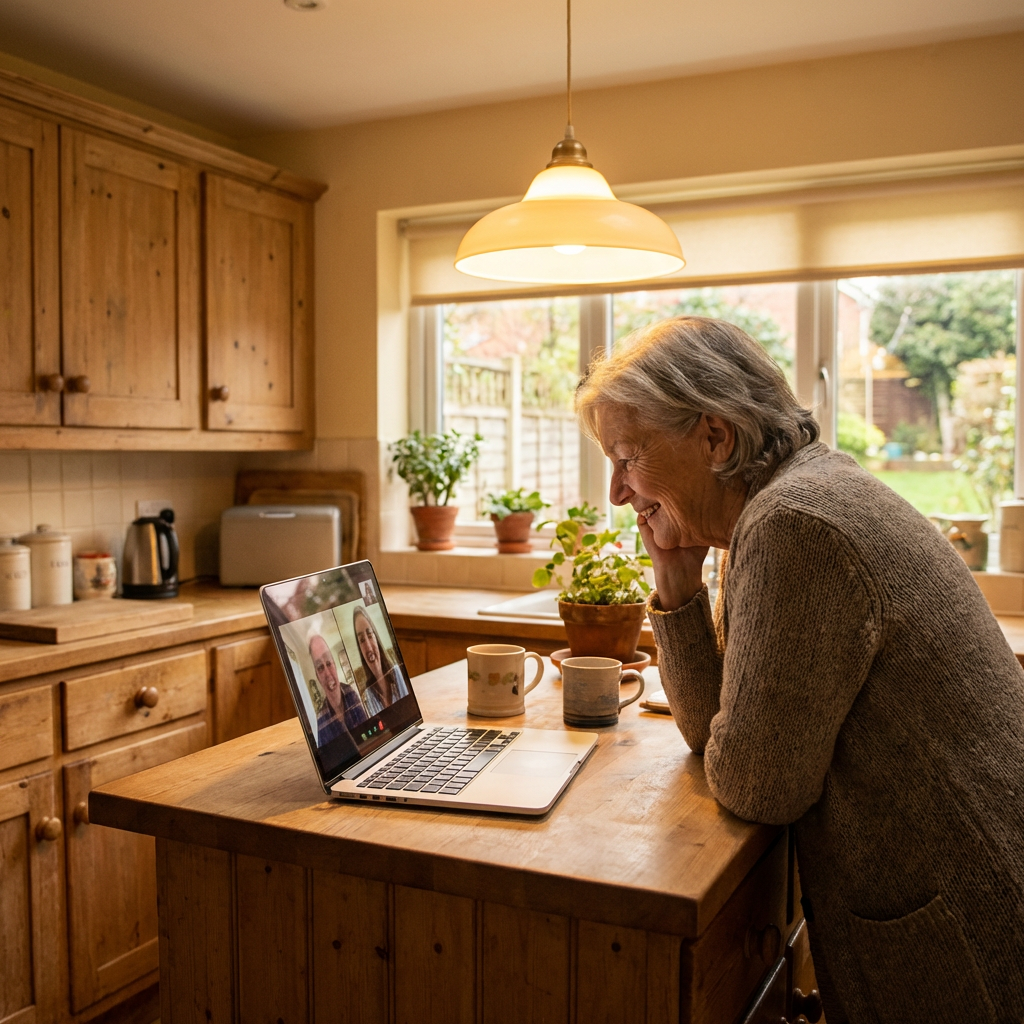
A warm, realistic editorial photograph of a woman in her late 60s sitting comfortably at a kitchen table with a laptop open in front of her. She is smiling slightly, reading the screen with an expression of pleasant surprise — the look of someone who just got a genuinely useful answer. A cup of coffee sits beside the laptop. Morning light comes through a nearby window. The mood is relaxed, domestic, and empowering — not clinical or techy. Warm amber tones, shallow depth of field. The image should feel like a real moment, not a staged stock photo.
1. Understanding Medical Information Without the Confusion
This is, without question, the thing I hear about most from seniors who’ve started using ChatGPT.
You leave a doctor’s appointment with a new diagnosis, a new medication, or a referral to a specialist — and you have questions. Real questions. Questions you didn’t think to ask in the office. Questions you’re not sure your doctor wants to hear again. Questions you’ve tried to research on Google, only to end up in a spiral of terrifying medical websites that assume the worst.
ChatGPT handles this differently.
What to type: “My doctor told me I have atrial fibrillation and prescribed metoprolol. Can you explain what atrial fibrillation is in simple terms, what metoprolol does, and what side effects I should watch for? Please keep it clear and easy to understand.”
What you get back is a calm, clear, jargon-free explanation that treats you like an intelligent adult. It won’t panic you. It won’t bury the important information in technical language. And if the first response raises more questions, you just ask them — like a real conversation.
Important note: ChatGPT is not a doctor and cannot diagnose anything. Always discuss decisions about your health with your actual physician. But for understanding what your doctor told you, in your own time, without feeling rushed? It’s genuinely excellent.
How I Published My First E-book at 70 with AI: A Senior’s Digital Revolution
2. Writing Letters and Emails When You’re Not Sure How to Start
Letter-writing used to be second nature. Now it feels like everything requires an email — to insurance companies, government agencies, doctors’ offices, landlords, contractors, family members you’re not sure how to reach.
The blank page problem is real. You know what you want to say. You just don’t know how to start. Or how formal to be. Or whether you’re being too pushy, or not direct enough.
ChatGPT solves this completely.
What to type: “I need to write a letter to my Medicare supplement insurance company. They denied a claim for a procedure my doctor said was medically necessary. I want to appeal the decision. Can you write a professional, polite but firm appeal letter for me? The procedure was a knee MRI and the claim number is 4872910.”
You’ll get a complete, professional letter in about 15 seconds. Read it over. Change anything that doesn’t sound like you. Print it and send it.
My neighbor used this exact approach after her insurance company denied coverage for a home health aide. The letter ChatGPT helped her write — which she reviewed and adjusted slightly — resulted in a successful appeal within three weeks.
Consulting Opportunities for Retired Professionals: A Practical, Experience‑Driven Guide for 2026
3. Planning Meals and Getting Recipes That Match Your Needs
Eating well gets more complicated as we get older. Dietary restrictions pile up. Low sodium for blood pressure. Reduced sugar for diabetes. Soft foods after dental work. High protein for muscle maintenance. Anti-inflammatory foods for arthritis. The list is different for everyone — and most recipe websites ignore all of it.
ChatGPT doesn’t.
What to type: “I’m 72 years old and need to eat a low-sodium, low-sugar diet. I also don’t eat red meat. Can you give me five easy dinner recipes for this week that are simple to prepare, use common ingredients, and don’t require a lot of standing at the stove? Please include a simple shopping list.”
What you get is a personalized meal plan that reflects your actual situation — not a generic healthy eating template that ignores your specific needs. You can follow up immediately: “That looks good but I don’t like fish. Can you swap the salmon recipe for something else?”
The back-and-forth conversation is where the real value is.
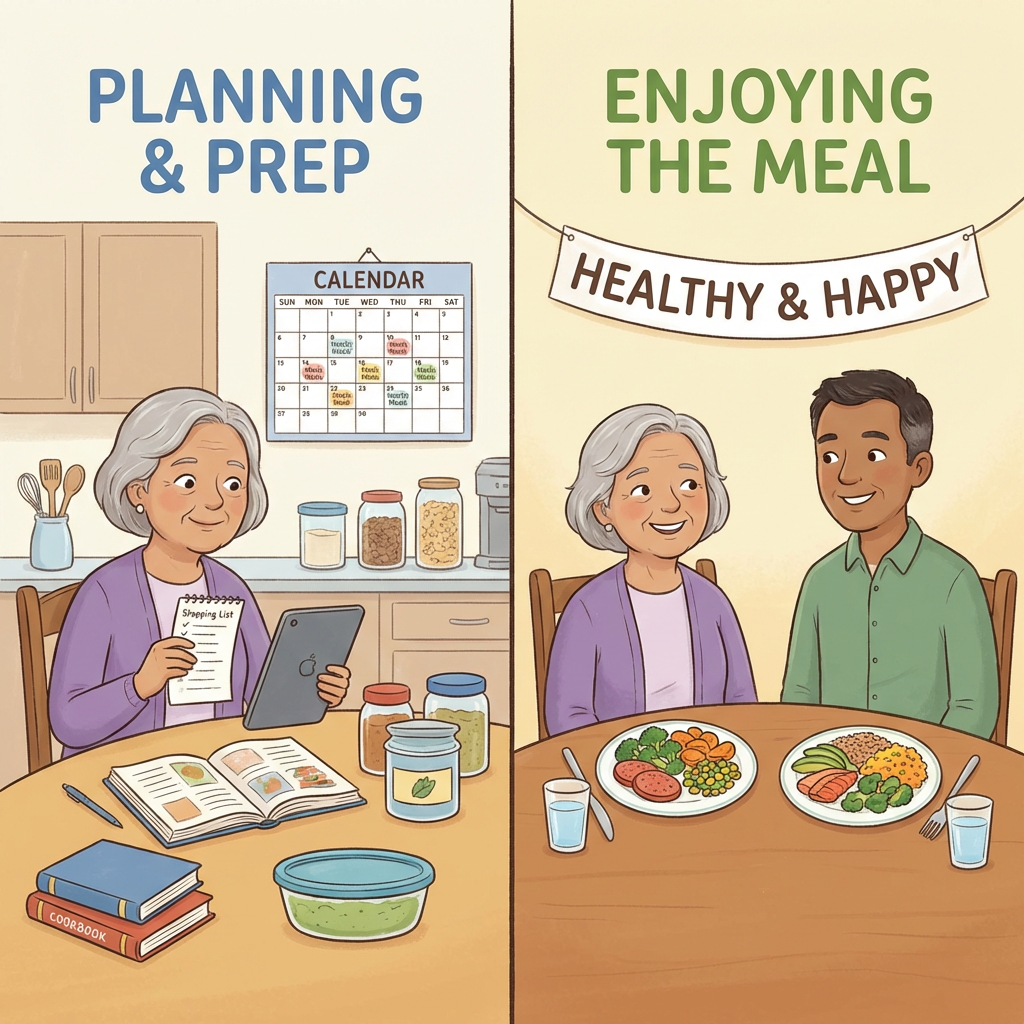
A warm, editorial-style illustration showing a split screen. On the left side: a senior man sitting at a kitchen counter looking slightly frustrated, surrounded by several open cookbooks and a piece of paper with crossed-out notes — representing the difficulty of finding recipes that match specific dietary needs. On the right side: the same man, now relaxed and smiling, reading from a tablet that shows a clear, organized meal plan. The kitchen is bright and homey. The illustration style is clean and warm — like something from a quality lifestyle magazine. Color palette: warm cream, kitchen-light amber, and a calm sage green.
4. Getting Help With Technology Problems
I know what you’re thinking. Using technology to solve technology problems feels circular. But hear me out.
When something goes wrong with your phone, tablet, or computer, the usual options are limited. You can call tech support and navigate a phone menu for 40 minutes. You can ask a grandchild who explains things too fast and gets impatient. You can Google the problem and get a list of forum posts that don’t quite match your situation.
ChatGPT is different because you can describe your specific problem in plain language and it gives you step-by-step instructions matched to your exact situation.
What to type: “I have an iPhone 14 and I can’t figure out how to make the text on the screen bigger. I’ve gone to settings but I can’t find the right place. Can you walk me through it step by step, in very simple terms?”
You can ask it to slow down, repeat a step, or explain something differently. It never sighs. It never checks its watch. It just keeps helping until you’ve solved the problem.
My father used this approach to figure out how to set up automatic bill payment on his bank’s website. He typed his question in plain language, followed the steps at his own pace, and did it himself — something he was convinced he’d need help with.
5. Explaining Your Legal Rights in Plain Language
Legal language is designed, it sometimes seems, specifically to confuse everyone who isn’t a lawyer. Leases. Wills. Medicare notices. Social Security documents. HOA agreements. Notices from government agencies.
Most of us sign or agree to things we don’t fully understand because the alternative is spending $300 an hour for an attorney to explain a one-page document.
ChatGPT won’t replace a lawyer when you actually need one. But for understanding what something says — in plain, everyday English — it’s remarkably useful.
What to type: “I received a letter from Social Security saying my Medicare Part B premium is increasing because of my income. The letter references something called IRMAA. Can you explain what IRMAA is, why it applies to me if my income is over a certain amount, and whether there’s any way to appeal it if my income has recently gone down?”
What follows is a clear, organized explanation of exactly what’s happening, why, and what your options are. You go into your next conversation with Social Security — or your accountant, or your attorney — actually knowing what you’re talking about.
6. Finding Activities, Clubs, and Local Resources
Isolation is one of the most serious health risks for seniors. We know this. The research is clear. But knowing you should be more socially connected and actually finding the right activities, clubs, or community resources are two very different things.
Local government websites are often confusing. Senior center calendars are sometimes buried five clicks deep. Word of mouth helps but isn’t always reliable.
ChatGPT can help you think through what you’re looking for and give you a starting point — including what to search for and what questions to ask.
What to type: “I’m 68 years old and recently retired. I live in Scottsdale, Arizona and I’m looking for social activities that might suit me. I enjoy history, hiking (light trails only), and board games. I don’t drive at night. Can you suggest the kinds of clubs, organizations, or activities that might be a good fit and tell me how to find them in my area?”
It will give you specific types of organizations to look for, exact search terms to use, and questions to ask when you call. It won’t magically know every local club — but it will give you a clear, organized starting point that saves real time.
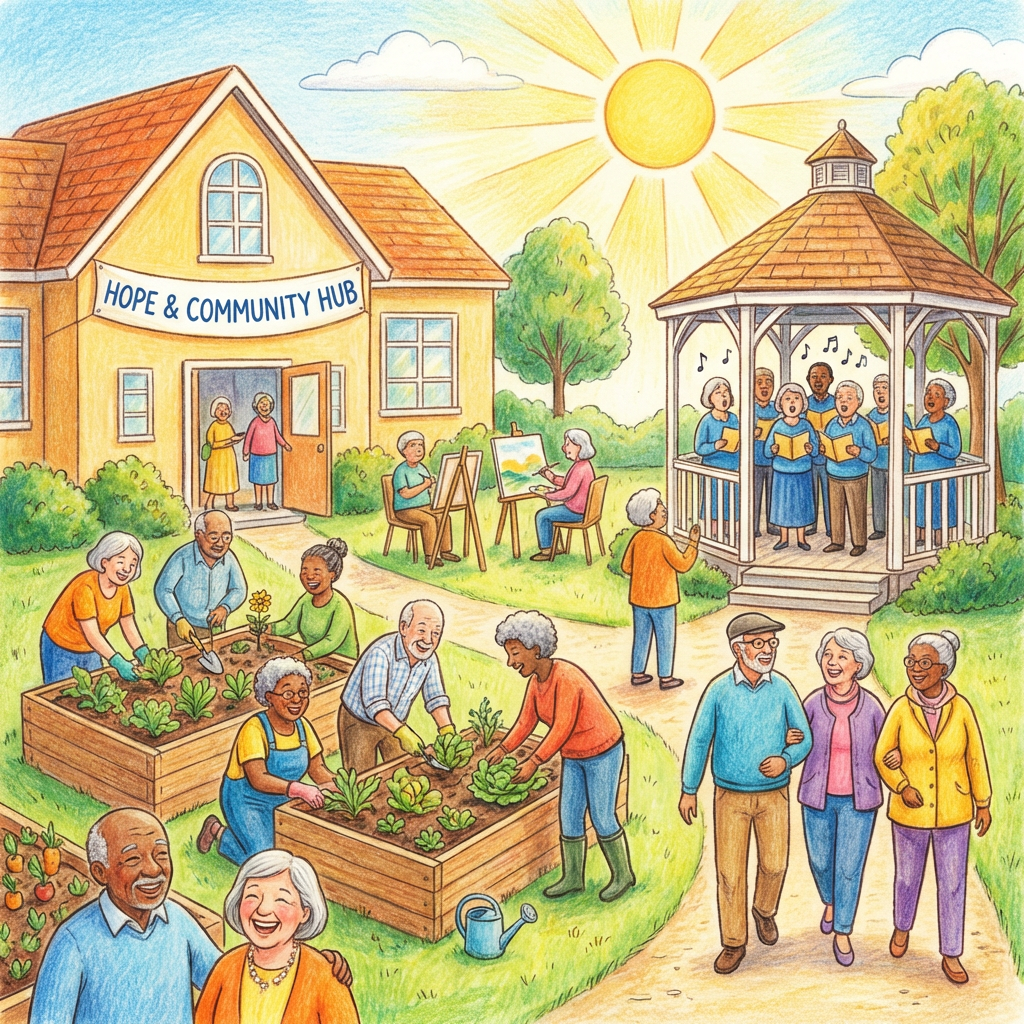
A joyful, warm editorial illustration showing a group of seniors engaged in a variety of activities in a bright community space. In one corner, two men play chess. In another, a small group examines a hiking map. A woman at a table gestures enthusiastically during a book discussion. Natural light fills the space. In the foreground, slightly separated from the group, a woman uses a tablet — suggesting she found this community through technology. The mood is inclusive, energetic, and hopeful. Color palette: warm oranges, greens, and soft blues. Friendly editorial illustration style, not cartoonish.
7. Getting Travel Help Tailored to Your Needs
Travel planning for seniors has specific complications that generic travel websites don’t address. Mobility considerations. Medical needs. Travel insurance questions. Finding accommodations that are actually accessible, not just technically compliant. Knowing which airlines or cruise lines have the best track records for older travelers with specific needs.
ChatGPT handles all of this — in a single conversation.
What to type: “My husband and I are 70 and 74. He uses a walking cane and tires easily. We want to take a trip to see the national parks in Utah — Zion, Bryce Canyon, and Arches — in September. We need to know which specific trails or viewpoints are accessible without difficult hiking, what time of year September is in terms of crowds and weather, what kind of accommodation to look for, and whether we need travel insurance given our ages. Can you help us plan this?”
The response covers all of it — and you can keep going. “Which park should we visit first?” “Is there a shuttle at Zion we can use instead of hiking?” “What questions should we ask the hotel about accessibility before we book?”
This is the kind of personalized, patient travel planning that used to cost money and take multiple phone calls.
8. Helping You Stay Sharp With Trivia, Puzzles, and Learning
Brain health matters enormously as we age. Staying mentally active — through learning, games, conversation, and intellectual challenge — is one of the most consistently evidence-backed strategies for cognitive health in older adults.
ChatGPT is a genuinely excellent thinking partner for this.
What to type: “I want to keep my mind sharp. Can you give me a history trivia quiz about World War II? Start with five questions, wait for my answers, and then tell me which ones I got right. After that, ask me five more harder questions.”
Or: “I’m interested in learning more about astronomy. I’m a complete beginner. Can you give me a short, interesting lesson about black holes — what they are, how they form, and why scientists think they matter? Then ask me a few questions to see if I understood it.”
Or: “Can you teach me five words in Italian today, with their pronunciation, and help me practice using them in a sentence?”
The interactivity is the key. It’s not just reading an article. It’s a genuine back-and-forth that engages your mind differently.
Flexible Jobs for People Over 60: Redefining Work in the Golden Years
9. Preparing for Important Conversations and Appointments
Some conversations require preparation. A difficult talk with an adult child about finances or living arrangements. A conversation with a doctor where you want to advocate strongly for a specific treatment. A meeting with an attorney about your will. A call to an insurance company to dispute a charge.
Going into these conversations unprepared is costly — financially, medically, emotionally. But preparing well takes time and knowing what you don’t know.
What to type: “I have an appointment with my cardiologist next week. I’ve been having more frequent episodes of shortness of breath and I want to make sure I ask the right questions and advocate for myself effectively. Can you help me prepare a list of specific questions to ask, things I should tell the doctor that he might not think to ask about, and what to do if I feel like he’s dismissing my concerns?”
What you get is a structured, comprehensive preparation guide that walks into the appointment with you — metaphorically speaking. People who use ChatGPT this way consistently report feeling more confident and better heard in medical settings.

*A calm, dignified editorial illustration of a senior woman sitting confidently across from a doctor in a bright medical office. She has a small notepad with organized notes in front of her and is speak
“Age is just a number. Don’t let AI intimidate you anymore.”
As a 71-year-old musician, I did it—and so can you. The world is changing rapidly, but AI is not here to leave us behind. Instead, it is the kindest assistant, ready to connect our lifelong experiences with the world.
I’ve removed all the confusing technical jargon and written my second book, <AI Made Simple for Seniors>, specifically from a senior’s perspective with clarity and ease. Let me walk beside you as you begin the second act of your digital life.
Leave a Reply