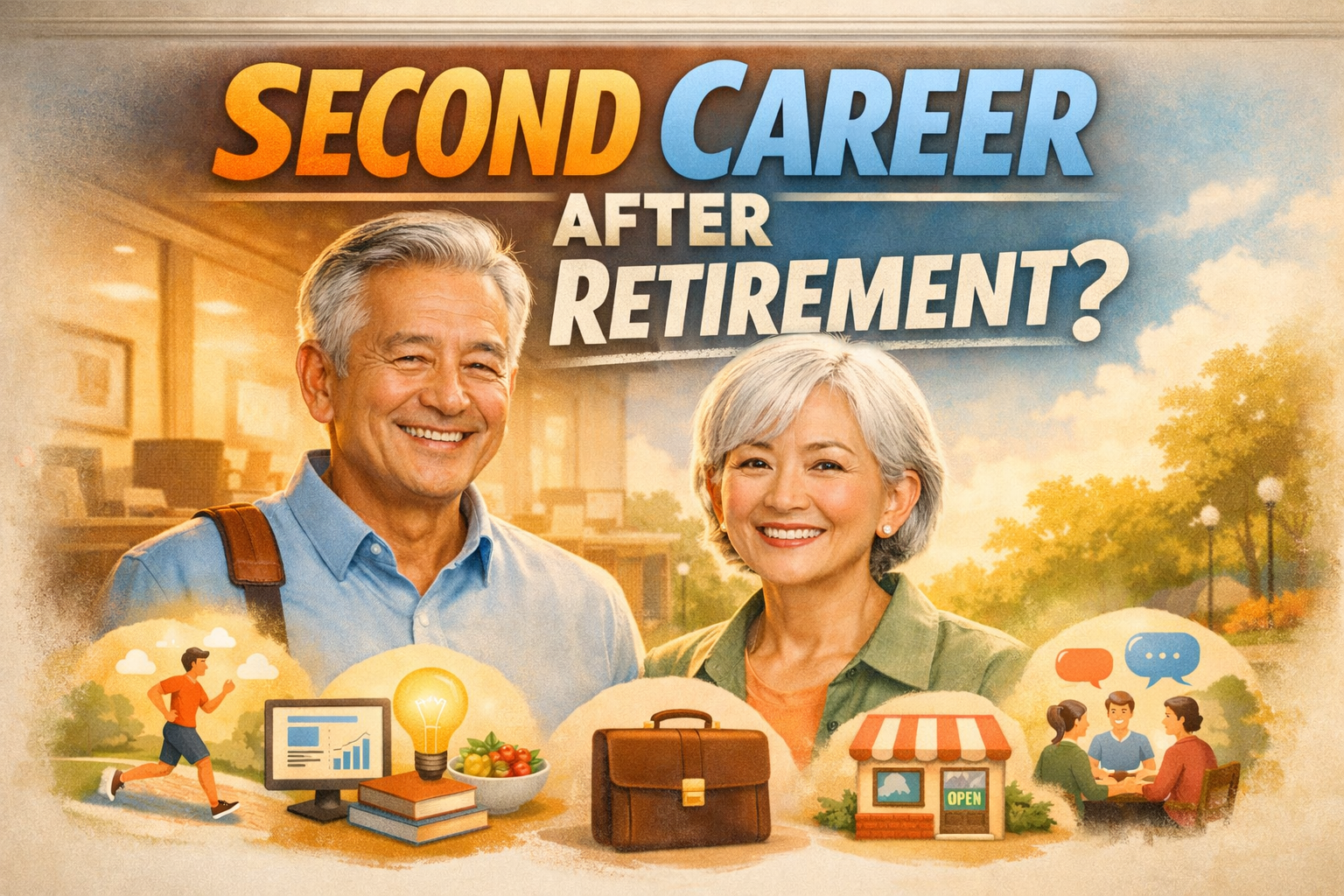
It’s not desperation. It’s not boredom. For millions of retirees, going back to work is one of the smartest — and most fulfilling — decisions they’ll ever make.
| THE SHORT ANSWER Most people who launch a second career after retirement do so by choice, not necessity. They want to stay sharp. They want to feel useful. They want income that doesn’t eat into their savings. And many — for the first time in decades — finally have the freedom to do work they actually love. If you’ve been wondering whether a second career makes sense for you, the evidence strongly suggests: for the right person, it’s one of the best moves you can make in your 60s and beyond. |
👉 “Don’t Just Retire, Bloom Again with AI!”
Are you ready to design a life of purpose, creativity, and connection after 60?
I spent my career accumulating real-world business wisdom. At 70, I discovered a powerful truth: AI isn’t just for the young. It’s the ultimate tool for us to transform our lifelong experience into a legacy.
My debut book, AI for Meaningful Living after 60, is your guide to Bridging the gap between your wisdom and wealth in the digital era.
It’s not about complex coding. It’s about practical steps to use AI to unleash your creativity, deepen your connections, and find daily joy.
👉 [Get Your Practical Guide to a Meaningful Retirement on Amazon Now! (Click Here)]
Here’s something nobody tells you about retirement: the silence can be deafening.
You spend 30, 40 years building toward it. The freedom. The rest. The well-earned break. And then one Tuesday morning — maybe six months in, maybe a year — you find yourself staring at the ceiling at 7 a.m. wondering what exactly you’re supposed to do with the next 25 years of your life.
This is the moment a lot of retirees start thinking about a second career. Not because they failed at retirement. But because retirement, it turns out, is not the finish line. It’s more like a starting gate.
The numbers back this up. According to data from the U.S. Bureau of Labor Statistics, workers aged 65 and older represent one of the fastest-growing segments of the American workforce. Globally, the trend is the same. Millions of people who technically “retired” are quietly going back to work — sometimes in the same field, often in something completely different — and reporting higher life satisfaction than those who stopped entirely.
So what’s really driving this? Let’s get into it.
| 26% of U.S. workers age 65+ remain in the workforce | 72% of retirees who return to work say they’re happier | $56K avg. median income of encore career professionals |
| A warm, editorial-style photograph of a confident man in his mid-60s, silver hair, wearing a casual blazer, sitting at a bright modern desk with a laptop and coffee mug. He is smiling slightly while reviewing documents. Natural morning light streams through a large window. The mood is purposeful and optimistic — not corporate, not rushed. Warm amber tones, shallow depth of field, lifestyle photography aesthetic. Caption: “For many retirees, a second career isn’t about needing money — it’s about needing meaning.” |

The Real Reasons Retirees Go Back to Work
Forget the stereotype of the desperate retiree who ran out of money. That story exists — but it’s not the dominant one. When researchers actually talk to people who start second careers, the answers are far more nuanced and, honestly, more inspiring.
1. They Ran Out of Something to Do (And It Scared Them)
Structure is underrated. When you’re working, your day has a shape. You have meetings, deadlines, colleagues who expect things from you. That structure — even when it’s stressful — gives life a rhythm.
Take it away suddenly, and the results can be disorienting. Studies on retirement and mental health consistently show that the first 12 to 18 months after leaving work are among the most psychologically vulnerable periods for older adults. Rates of depression spike. Cognitive decline can accelerate.
A second career solves this elegantly. It provides structure without the suffocating rigidity of the old job. And unlike “keeping busy” with hobbies, it carries real stakes — which turns out to matter a lot for psychological well-being.
2. Identity Doesn’t Retire When You Do
For most people, professional identity is deeply woven into who they are. Ask someone to describe themselves, and within two sentences they’ll tell you what they do for a living. Decades of expertise, reputation, professional relationships — this doesn’t just evaporate when you collect your gold watch.
Many retirees report a quiet grief at losing that identity. Not grief for the job itself, but for the version of themselves that the job represented. A second career — especially one that draws on accumulated expertise — allows people to carry that identity forward rather than abandon it.
This is why so many second careers are built on consulting, coaching, teaching, or mentoring. The knowledge doesn’t go away. It just needs a new container.
Consulting Opportunities for Retired Professionals: A Practical, Experience‑Driven Guide for 2026
3. The Math Changed — And Not in Their Favor
Let’s be honest about the financial reality too. People are living longer. A 65-year-old today has a reasonable chance of living to 85 or 90. That’s 20 to 25 years of expenses that need to be funded.
Traditional retirement savings models weren’t built for this timeline. Social Security was designed when life expectancy was considerably lower. Pension plans have largely disappeared from the private sector. And the 4% withdrawal rule — the old standby of financial planners — starts to look shaky when you run the numbers out to 30 years.
Working even part-time during the early years of retirement can dramatically change the math. If you earn $30,000 to $40,000 per year through a second career, you’re not just covering expenses — you’re preserving your nest egg and potentially letting it grow. Even a five-year second career can add years of financial security to the back end of retirement.
| “The question isn’t whether you can afford to retire. It’s whether you can afford to stay retired for 30 years without doing anything.” — Certified Financial Planner, quoted in The Atlantic |
4. Healthcare Is a Massive, Practical Driver
In the United States especially, healthcare is one of the most underappreciated reasons retirees return to work.
Medicare eligibility begins at 65. But many people retire before 65 — and private health insurance for a 60-year-old can run $800 to $1,200 per month or more. That’s before any deductibles or co-pays.
A part-time or full-time job with employer-sponsored health benefits can save a pre-Medicare retiree tens of thousands of dollars a year. For many, this single factor alone tips the decision.
10 Everyday Things Seniors Can Ask ChatGPT
5. They Finally Get to Do What They Actually Wanted
This might be the most underreported reason of all: freedom.
Many people spent their entire first career in jobs they stumbled into, stayed in for stability, or endured for the salary. Retirement strips away those constraints. For the first time, the question isn’t “what job can I get?” but “what do I actually want to do?”
The result is a remarkable flowering of second careers that look nothing like the first. The accountant who becomes a sailing instructor. The engineer who opens a woodworking studio. The nurse who starts a nonprofit. The corporate lawyer who teaches community college courses on legal literacy.
These aren’t career pivots born of failure. They’re career pivots born of finally having enough freedom — and enough self-knowledge — to build something truly personal.
| A split-panel illustration in a clean editorial style. Left panel: a tired-looking professional in a formal suit sitting at a crowded corporate desk, surrounded by stacks of paper and a clock on the wall. Right panel: the same person, visibly lighter and energized, teaching a small workshop class in a bright community space, gesturing toward a whiteboard. Warm illustration style, “ |

Advantages of Starting a Career Later in Life
What the Research Actually Says About Working After Retirement
The anecdotes are compelling. But the research is genuinely surprising.
A long-running study from Cornell University found that individuals who continued some form of paid work after traditional retirement age reported significantly better cognitive function, lower rates of depression, and stronger social connections than those who stopped working entirely. The relationship held even when controlling for health status and income.
A separate study published in the Journal of Occupational Health Psychology found that the key variable wasn’t just working — it was working in a role that felt meaningful and somewhat autonomous. Retirees stuck in low-quality, low-choice jobs showed no mental health benefit. But those in roles that matched their interests and allowed flexibility showed the same mental health profile as people who were flourishing in their primary careers.
The takeaway: it’s not just about going back to work. It’s about going back to the right kind of work.
The ‘Bridge Employment’ Research
Economists and gerontologists have a specific term for the work people do between full-time career employment and complete retirement: bridge employment.
Research on bridge employment consistently shows that it eases the psychological transition out of full-time work, reduces financial stress in the early retirement years, and is associated with longer, healthier lives. People who use bridge employment are also more likely to fully retire contentedly when they eventually do — as opposed to those who go cold turkey and often experience a difficult adjustment period.
Cognitive Benefits Are Real — and Significant
One of the most striking findings in recent gerontology research involves cognitive reserve. The brain responds to challenge much the same way muscles do: use it or lose it.
Mentally stimulating work — learning new systems, solving novel problems, communicating complex ideas — builds what researchers call cognitive reserve. This reserve acts as a buffer against age-related cognitive decline and even dementia onset.
This doesn’t mean staying in a stressful, high-pressure job. It means doing work that requires genuine thinking and learning. And interestingly, this is often exactly what second careers deliver — because people in encore careers are frequently learning entirely new skills and industries.
| 40% lower risk of depression reported in working retirees vs. non-working peers | 3x more likely to describe themselves as ‘thriving’ vs. fully retired counterparts |
What Second Careers Actually Look Like in Practice
Let’s get concrete. Second careers aren’t monolithic. They take many different shapes depending on what you want, what you know, and how much flexibility you need.
The Consultant Route
This is the most natural transition for professionals who built deep domain expertise over their careers. Former executives, engineers, financial professionals, HR specialists, and countless others find that companies — particularly smaller ones — will pay handsomely for access to experience they can’t afford to hire full-time.
Consulting offers tremendous flexibility. You choose your clients, set your rates, and work on your own schedule. The income can be substantial — many experienced consultants earn more per hour than they did in their final salaried roles.
Teaching, Coaching, and Mentoring
For those drawn to sharing what they know, the education sector — formal and informal — offers rich opportunities. Community college adjunct positions, corporate training contracts, executive coaching certifications, and online course creation are all viable pathways.
The rise of platforms like Coursera, Teachable, and Skillshare has made it possible for someone with genuine expertise to reach thousands of students without ever entering a classroom. A retired CFO who creates a course on small business financial planning can build a meaningful income stream while genuinely helping people.
Entrepreneurship and Small Business
Retirement provides something most aspiring entrepreneurs never had during their working years: time. Retirees who’ve always wanted to start something now have the space to do it thoughtfully — without the desperation or recklessness that can sink early-stage businesses.
Many retire-to-entrepreneur stories involve passion projects: a B&B in wine country, a specialty food business, a small-batch craft company. But others are decidedly strategic — using retirement to finally pursue the business idea that kept getting shelved during the busy decades.
Nonprofit and Mission-Driven Work
Money isn’t always the point. For many retirees, the second career is an opportunity to redirect decades of professional skill toward causes they care about deeply. Nonprofits, social enterprises, community organizations, and faith-based institutions often need exactly the kind of experienced leadership that retired professionals can offer.
The psychic rewards of mission-driven work are hard to overstate. Multiple studies have found that perceiving one’s work as meaningful is one of the strongest predictors of well-being in older adults — stronger even than income or social contact.
| A candid, warmly-lit photograph of three people in their 60s gathered around a small table in a co-working or community café space. One woman is gesturing expressively while the other two lean in, engaged. All three appear confident, relaxed, and intellectually alive — the feeling of experienced professionals collaborating. Soft natural light, mugs on the table, notepads open. The aesthetic should feel like a magazine feature on modern aging. Diverse representation, authentic energy. Caption: “Second career communities often provide the richest professional relationships of a person’s working life.” |

The Real Challenges — And How to Navigate Them
It would be dishonest to write this piece without addressing the difficulties. Starting a second career isn’t always smooth. Here are the most common obstacles — and how people successfully work through them.
Ageism Is Real (But Not Insurmountable)
Let’s not pretend age discrimination doesn’t exist in hiring. It does. Research from the AARP and various academic institutions has documented significant bias against older job applicants, particularly in technology and fast-moving industries.
The most effective counter-strategies are practical rather than combative. Focus on industries and roles where experience is genuinely valued — healthcare, finance, education, consulting, and skilled trades. Build a current digital presence through LinkedIn and professional communities. Emphasize adaptability and recent learning, not just legacy credentials. And consider entrepreneurship or freelancing, which bypasses hiring gatekeepers entirely.
Technology Can Feel Like a Wall
Many retirees feel genuine anxiety about how much the professional technology landscape has changed. New software platforms, remote work tools, digital marketing, AI-assisted workflows — it can feel like a foreign country.
The key insight here is that you don’t need to master everything. You need to be proficient enough in the tools relevant to your specific second career. Community colleges, YouTube tutorials, and platforms like LinkedIn Learning offer accessible, structured paths to building modern digital skills.
Energy and Pace Management
The second career, almost by definition, needs to be structured differently than the first. Grueling 60-hour weeks are neither necessary nor wise. The most sustainable second careers are built around part-time commitments, flexible hours, remote work arrangements, or project-based engagements that allow for real recovery time.
This isn’t a compromise — it’s an advantage. The flexibility to work intensely for a period and then step back is something your 35-year-old self would have envied deeply.
Social Security and Tax Considerations
Before launching a second career, a conversation with a financial planner who specializes in retirement is strongly advisable. Working while collecting Social Security — particularly before full retirement age — can temporarily reduce benefits. Income from a second career may also bump you into higher tax brackets or affect Medicare premiums.
None of this should stop you. But going in without understanding the numbers is a mistake easily avoided.
| A stylized flat-design infographic illustration showing a winding road that starts at a conventional office building labeled ‘First Career’ and curves through stages like ‘Retirement Gate,’ ‘Bridge Employment,’ and ‘Encore Career’ before reaching a vibrant destination labeled ‘Purpose + Income.’ Along the road, small illustrated scenes show a person consulting, teaching, starting a business, and volunteering. Color palette: warm terracotta, sage green, and gold on a cream background. Friendly but sophisticated editorial illustration style. Caption: “The second career journey rarely looks like a straight line — and that’s exactly what makes it interesting.” |

How to Actually Start Your Second Career: A Practical Framework
Thinking about it is easy. Starting is harder. Here is the framework that most successful encore career professionals actually follow.
Step 1: Audit What You Actually Have
Sit down with a blank page and list every skill, domain of knowledge, professional relationship, credential, and hard-won insight you’ve accumulated over your career. Be exhaustive. Most people dramatically underestimate their own knowledge base until they lay it out explicitly.
Step 2: Clarify What You’re Actually Optimizing For
What does “success” actually mean to you in this phase of life? Ask yourself:
- Supplemental income with minimal stress?
- Maximum income with ambitious growth?
- Social connection and intellectual stimulation?
- Mission and impact, regardless of pay?
- Part-time flexibility above all else?
There are no wrong answers. But conflating these goals leads to confusion and bad decisions. Know what you’re actually chasing.
Step 3: Start Small, With Low Stakes
The worst second career launches begin with a big, irreversible commitment. The best ones begin with small experiments that let you test assumptions before going all in. Take one consulting project before declaring yourself a consultant. Teach one course before building a teaching business.
Step 4: Rebuild Your Network Deliberately
Professional networks atrophy in retirement. Rebuilding — or building a new network in a new field — is necessary work, and it’s more enjoyable than most people expect. LinkedIn, industry associations, alumni networks, and community organizations are all good starting points.
Step 5: Give It a Genuine Timeline
Second careers often start slowly. The first six months may feel uncertain and underpowered. This is normal. Most successful encore careers hit their stride at the 12 to 24-month mark. Give yourself a real runway before judging whether it’s working.
| 10 Key Tips for Launching a Successful Second Career The tips that come up again and again from retirees who’ve done this successfully: | |
| 1 | Start before you fully retire. The best second careers are often seeded 1–2 years before leaving the first one. |
| 2 | Choose flexibility over income (at first). A second career that fits your life is more sustainable than one that pays more but demands everything. |
| 3 | Get your tax and Social Security picture clear before you start earning. |
| 4 | Invest in one key digital skill most relevant to your second career and master it. |
| 5 | Don’t undersell yourself. Decades of experience have real market value. Charge accordingly. |
| 6 | Build a simple online presence — even a clean LinkedIn profile and a basic personal website signals seriousness. |
| 7 | Look for ‘bridge’ roles first — part-time, contract, or fractional roles ease the transition. |
| 8 | Let go of seniority expectations. Starting fresh sometimes means accepting junior arrangements temporarily. |
| 9 | Tell people what you’re doing. Most opportunities arrive through personal networks, not job applications. |
| 10 | Give yourself permission to love it. Enjoyment is a legitimate goal — and a health strategy. |
| Summary: Key Takeaways |
| The most common drivers are purpose, structure, social connection, financial security, and personal freedom — not desperation. |
| Research consistently links post-retirement work to better mental health, stronger cognitive function, and higher reported life satisfaction. |
| The most successful second careers are built on existing expertise, genuine flexibility, and realistic financial goals. |
| Ageism and technology gaps are real barriers — but both are navigable with the right strategies. |
| The ideal second career doesn’t look like the first one — it’s designed around what you actually want now. |
| Starting small and giving yourself a genuine 12–24 month runway dramatically improves the odds of success. |
| Financial planning — specifically around Social Security, taxes, and healthcare — is non-negotiable before you begin. |
| The world is full of 65- and 70-year-olds doing some of the most interesting, generative, and rewarding work of their lives. There’s no rule that says the best chapter of your career has to come before retirement. For a lot of people, it comes after. |
Flexible Jobs for People Over 60: Redefining Work in the Golden Years
It’s never too late to learn, grow, and discover new possibilities.
Explore the books of Han Jong-Woo, where artificial intelligence, lifelong learning, personal growth, and meaningful living come together to inspire your next chapter.
Whether you’re curious about AI, seeking purpose, or simply looking for fresh inspiration, you’ll find books designed to encourage, empower, and enrich your life.
▶ Visit Han Jong-Woo’s Amazon Author Page and discover all of his books today.
Leave a Reply