“Experience is your asset. AI is your tool.”
Learn how I turned my lifelong knowledge into a $1,000 monthly income stream using AI. Simple, practical, and designed specifically for our generation.

📖 Check out my new book on Amazon!
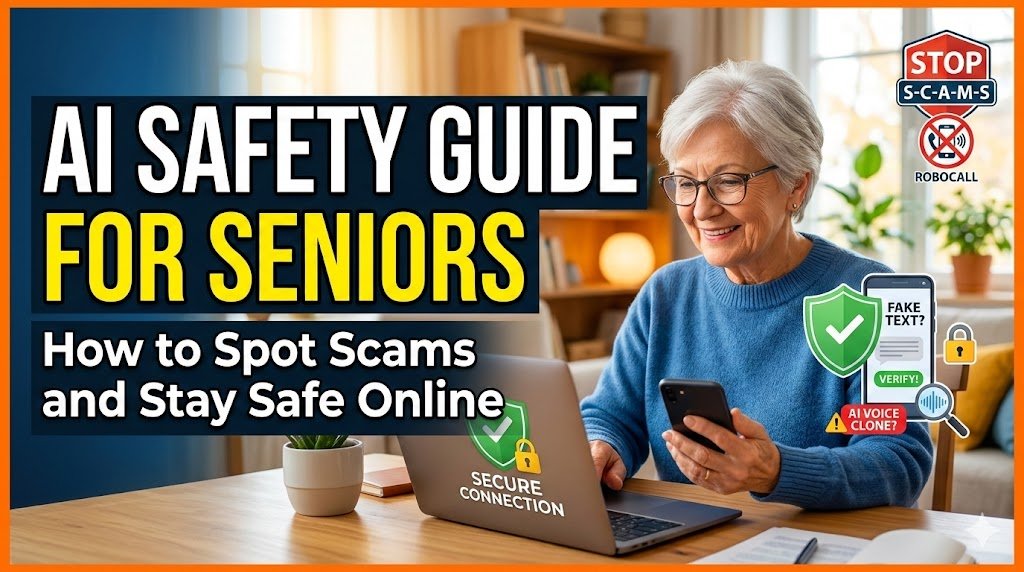
Here’s what you need to know right now: AI scams targeting seniors have crossed the $1 billion mark since 2024 — and that number is climbing fast. The good news? You don’t need to be a tech expert to protect yourself. You just need to know what these scams look like, why they work so well, and five simple habits that block most of them cold. This guide covers all of that, in plain language, with no jargon.
“A realistic digital illustration of a 68-year-old woman with reading glasses sitting at a kitchen table, looking cautiously at her smartphone screen. Her expression shows concern and alertness — not panic, but careful awareness. A warm overhead light illuminates the space. A cup of tea is nearby. The phone screen subtly glows with a suspicious-looking text message. Mood: protective, vigilant, informative. Warm color palette.”

Why Seniors Are the #1 Target for AI Scams
Let’s start with something uncomfortable.
Criminals don’t pick victims randomly. They study who has money, who answers the phone, and who is most likely to trust what they hear. Seniors check all three boxes.
It’s not a matter of intelligence. Some of the smartest people alive have been taken. A retired attorney in New York lost $468,000 to a romance scam in 75 days. An 82-year-old veteran lost $97,000 to a fake government investment scheme. These are educated, accomplished people — not easy marks by any stretch.
So why does it keep happening?
A few reasons that researchers have identified:
Saved-up trust. People who grew up before the internet were taught that if someone calls you, they’re real. That instinct was accurate for most of your life. Scammers exploit it.
Financial stability. Seniors often have retirement savings, home equity, or predictable monthly income. That makes them high-value targets compared to, say, a 28-year-old with $400 in their checking account.
Isolation. Many older adults live alone or have limited social contact. Scammers are trained to fill that gap — to be warm, patient, and friendly before they ask for anything.
And now, AI. This is where everything changed.
Why AI is becoming important after age 60
What AI Has Done to Scams — And Why It Matters
Until about two years ago, you could spot most scams by their obvious flaws. Bad spelling. Weird grammar. A Nigerian prince who needed your bank account number. Those tells are gone now.
AI has made scammers terrifyingly good at their jobs.
Here’s what the technology actually enables:
Perfect writing. AI generates emails that read like they were written by your actual bank. No typos. No awkward phrasing. Perfectly matched to the company’s real tone and branding.
Voice cloning. This one still shocks people when they first hear about it. Using just 3–10 seconds of someone’s recorded voice — pulled from a YouTube video, a Facebook post, a voicemail — AI can create a copy of that voice that speaks any words a criminal types. Your grandchild’s voice. Your doctor’s voice. Even your own voice.
Deepfake video. AI can now create video of a real person saying things they never said. A “video call” from someone who looks and sounds exactly like your bank manager asking you to move money to a “safe account” is now technically possible — and happening.
Personalized targeting. Machine learning scans leaked databases, social media profiles, and public records to build a detailed picture of you before they even make contact. They know your name, your city, your family members’ names, your interests. The call feels personal because it is personal — just not in a good way.
The 7 AI Scams Seniors Need to Know
1. The Grandchild Emergency Scam (Now Powered by Voice Cloning)
This one has been around for years. What’s new is how convincing it’s become.
A senior gets a call. It sounds exactly like their grandson: “Grandma, I’m in trouble. I was in a car accident. Please don’t call Mom and Dad — they’ll freak out. I just need $3,000 wired to cover the hospital bill.”
Before AI, the voice was an impersonator guessing. Now, the voice is a clone built from the grandson’s actual TikTok videos or Instagram reels. It sounds real because it’s using his real voice patterns, his real cadence, his real way of saying “Grandma.”
The tell: Any call asking for money AND secrecy at the same time is a scam. Always. Hang up and call the person directly on a number you already have saved.
2. The Fake Tech Support Scam
Your screen suddenly shows a warning: “VIRUS DETECTED. Call Microsoft Support immediately: 1-800-XXX-XXXX.”
You call. A polite, patient “tech support agent” asks for remote access to your computer to “fix the problem.” Once they have access, they install real malware, view your saved passwords, and drain whatever financial accounts they can reach.
The original pop-up was fake. The warning was generated by a simple script. But the damage done once you hand over access is very real.
The tell: Microsoft, Apple, and Google never call you. They never display a phone number in a pop-up window. Never give anyone remote access to your computer unless you personally initiated the contact through the company’s official website.
3. AI-Powered Phishing Emails
An email from what looks like your bank. From your Medicare provider. From the IRS. From Amazon saying there’s a problem with your order.
The old version of these emails was easy to spot — logos were wrong, links were obviously fake, the language was clunky.
The new version is indistinguishable from the real thing. AI generates them in bulk, customized to sound like they know you. The link they include leads to a website that looks exactly like your bank’s website — right down to the padlock icon in your browser.
You enter your username and password. The scammer has them within seconds.
The tell: Never click links in emails about your accounts. Instead, close the email and go directly to the website by typing the address yourself. If there’s really an issue with your account, it’ll show up there.
4. The Romance Scam
This is the most emotionally brutal one on the list, so I’m going to be direct about it.
Someone contacts you on a dating site, Facebook, or even by “wrong number” text. They’re warm, attentive, thoughtful. They remember what you told them last week. They compliment you. Over weeks or months, they build a genuine emotional bond.
Then a crisis hits. They need money. Just once. Then again. Then again.
AI has made romance scammers superhuman. They manage dozens of “relationships” simultaneously, using AI to track what each victim said and generate perfectly tailored responses. The connection feels real. The person is not.
The tell: If you’ve never met someone in person, and they start talking about money — for any reason — the relationship is a scam. Full stop.
5. The Medicare and Social Security Imposter
A call from someone claiming to be from Medicare. Your benefits are at risk. Your Social Security number was “compromised.” You need to confirm your information or move your benefits to a “secure account.”
AI makes these calls more convincing than ever. The caller ID shows a legitimate government number (that’s called “spoofing” — easy to fake). The caller knows your name, your general location, sometimes even your date of birth from leaked databases.
The tell: Social Security and Medicare never call you to ask for personal information. They communicate by mail. If someone claiming to be from the government calls asking for your SSN, hang up immediately.
6. The Investment and Cryptocurrency Scam
This is the most financially catastrophic scam on this list. Investment fraud alone cost Americans over 60 a reported $6.5 billion in 2024.
A scammer — posing as a financial advisor, a friend, or even a romantic interest — introduces you to a “guaranteed” investment opportunity. Usually cryptocurrency. The fake platform they show you looks professional. Your balance appears to grow. You might even be allowed to “withdraw” a small amount at first to build trust.
Then you try to withdraw more. Suddenly there are fees. Taxes. Processing charges. Every payment you make disappears. The platform eventually vanishes.
The tell: No legitimate investment guarantees returns. No real financial advisor contacts you out of nowhere. If someone online is talking to you about investing, stop.
7. The Deepfake Video Call Scam
This is the newest and perhaps most unsettling.
A video call comes in from someone who looks like your bank manager, your doctor, or a government official. They show you a screen. They explain a problem. They ask you to authorize something or transfer funds.
The face and voice are AI-generated in real time.
This technology is still developing, but it’s already being deployed. The FBI has issued explicit warnings about it.
The tell: Any video call requesting financial action should be treated with extreme suspicion. End the call and contact the institution directly using official contact information.
“A clean, modern infographic-style illustration showing 4 warning signs of AI scams, each in its own rounded box. Box 1: A phone with a suspicious caller ID — labeled ‘Calls claiming to be your bank or government.’ Box 2: An email icon with a hook through it — labeled ‘Links asking you to log in.’ Box 3: A person on a video call with a glitching face — labeled ‘Deepfake video requests.’ Box 4: A heart with a dollar sign — labeled ‘Online romance asking for money.’ Color palette: warm reds and yellows on white background. Clean sans-serif fonts. Warning/alert aesthetic.”

Online Safety for Elderly Adults: 5 Habits That Block Most Scams
Here’s the practical part. These aren’t complicated. They don’t require any apps or technical knowledge. They just require making them habits.
Habit 1 — Create a “Family Code Word”
Sit down with your family and agree on a private word that only you know. Something specific and random — “purple umbrella,” “Tuesday meatball,” whatever you like.
If you ever get an emergency call from a family member asking for money, ask them to say the code word. A scammer cannot know it. A real family member will.
This single habit neutralizes the voice cloning grandchild scam entirely.
Habit 2 — Never Act on Urgency
Scammers manufacture pressure because pressure disables careful thinking. “Act in the next 30 minutes or your account will be closed.” “Don’t hang up or you’ll be arrested.”
Real banks, real government agencies, and real family members will still be there in an hour. Always.
If anyone creates urgency — any urgency at all — that is your signal to slow down, not speed up. Hang up. Call back on a number you already know. Or tell a trusted person what just happened and ask their opinion.
Taking 24 hours before acting on any unexpected financial request will prevent the vast majority of scams.
Habit 3 — Protect Three Things Like Gold
There are three pieces of information that, in the wrong hands, can cause enormous damage:
Your Social Security number. Your bank account details. And your passwords.
No legitimate company needs to ask you for these over the phone or via email. If anyone asks for any of these three things unexpectedly — regardless of how official they sound — say no and hang up.
It’s not rude. It’s survival.
Habit 4 — Set Up Two-Factor Authentication
This is the one genuinely technical habit on this list, and it’s worth the five minutes it takes.
Two-factor authentication (2FA) means that even if someone has your password, they still can’t get into your account without also having your phone. When you log in, the website sends a code to your phone. You enter the code. You’re in.
Turn this on for your email, your bank, and your social media accounts. Your bank or email provider can walk you through it if you call them.
This single setting stops the most common version of account theft cold.
Habit 5 — Talk About It Out Loud
One of the scammer’s most reliable tools is shame. They know that if you’re embarrassed, you won’t tell anyone. They specifically ask you to keep things secret.
Break that dynamic. Talk about suspicious calls and messages with family members, friends, or anyone you trust. Even just saying “I got a weird call today” out loud gives someone else the chance to say “that sounds like a scam.”
The more we talk about this, the harder it gets for scammers to operate.
“A warm and realistic digital illustration of a multigenerational family — a senior woman in her late 60s, her adult daughter around 40, and a teenage grandson — sitting together at a dining table with a laptop open. They are having a calm, engaged conversation about the screen. The senior woman looks attentive and empowered, not confused or afraid. A notebook with handwritten notes is visible. Cozy evening lighting. The mood should be protective, connected, and reassuring.”

What To Do If You’ve Already Been Scammed
First: it is not your fault. The people running these operations are professionals. They study psychology, use sophisticated technology, and practice their techniques daily. Being deceived by them does not reflect on your intelligence.
Here is what to do immediately:
Stop all payments. If you sent a wire transfer, call your bank right now and ask if it can be recalled. Speed matters enormously — transfers can sometimes be reversed within hours.
Call your bank. Report what happened. Ask them to flag your accounts and monitor for unusual activity. Change your passwords.
Report it to the FTC at ReportFraud.ftc.gov. Also report to the FBI’s Internet Crime Complaint Center at ic3.gov. These reports help law enforcement track patterns and catch the people doing this.
Call the AARP Fraud Watch Helpline: 877-908-3360. They have trained staff who have handled thousands of these situations. They won’t judge you. They’ll help you figure out next steps.
Tell someone you trust. Isolation after a scam makes everything worse. The feelings of embarrassment and grief are real and valid — but you shouldn’t carry them alone.
AI Security Tips: The Short Version for Everyday Use
Sometimes you just need a quick reference. Here it is:
Before answering a suspicious call, remember: government agencies contact you by mail, not by phone.
Before clicking any link in an email: go directly to the website by typing the address yourself.
Before sending money to anyone: wait 24 hours and tell a trusted person first.
Before giving anyone remote access to your computer: don’t. Unless you called a company’s official number first.
Before investing in anything online: talk to a licensed, in-person financial advisor.
“A clean, empowering poster-style illustration with the headline ‘Stay Safe Online’ in bold sans-serif text. Below it, five illustrated icons in a row: a shield for password protection, a phone with an X for rejecting suspicious calls, a padlock for two-factor authentication, a family silhouette for ‘talk to someone,’ and a clock for ‘wait 24 hours.’ Soft blue and green color scheme on a white background. Professional, modern, and accessible design for older adults.”

Summary and Key Takeaways
Here’s what this guide covered, condensed for easy reference.
The scale of the problem is real and growing. Americans 60 and over reported around $5 billion in scam losses in 2024. AI has made these scams dramatically harder to detect and dramatically easier to run at scale.
AI gives scammers four new weapons: perfect writing, voice cloning, deepfake video, and personalized targeting. Each one alone is dangerous. Together, they’re formidable.
The seven AI scams hitting seniors hardest right now are the grandchild voice clone emergency, fake tech support, AI phishing emails, romance scams, government impersonation, investment fraud, and deepfake video calls.
Five habits protect you against most of them: create a family code word, never act on urgency, protect your SSN and bank details fiercely, set up two-factor authentication, and talk about suspicious contacts out loud with people you trust.
If something does happen, stop payments immediately, call your bank, report to the FTC and FBI, and contact AARP’s Fraud Watch Helpline.
✅ 10 Key Tips — Print This and Put It on Your Fridge
- Government agencies contact you by mail. A phone call claiming to be the IRS or Social Security is always a scam.
- Create a family code word to verify emergency calls from relatives.
- Never click email links to log into your bank, Medicare, or any financial account. Type the address yourself.
- Urgency is a weapon. If someone pressures you to act “right now,” slow down — not speed up.
- No investment is guaranteed. Anyone promising guaranteed returns is lying.
- A voice can be cloned. Even if it sounds like your grandson, ask for the code word.
- Remote computer access is almost always a scam. Legitimate companies don’t ask for it out of the blue.
- Turn on two-factor authentication for your email and bank accounts.
- Talk about it. Tell someone when you get a suspicious call. Silence protects scammers, not you.
- AARP Fraud Watch: 877-908-3360. Save this number. Use it if anything feels wrong.
One Final Thought
The internet is genuinely wonderful. AI genuinely helps people every day. This guide isn’t meant to make you afraid of technology — it’s meant to give you the specific knowledge that keeps you safe while you use it.
Knowing what a scam looks like is the difference between being a target and being a protected, confident, fully-connected person who uses technology on your own terms.
You’ve navigated a lot of change in your lifetime. This is one more thing to learn. And now you know it.
SEO Keywords used naturally throughout: ai scams targeting seniors, online safety for elderly, ai security tips, senior scam prevention, voice cloning scams, deepfake fraud, phishing emails elderly, AARP fraud helpline
Best AI Tools for Seniors in 2026 (Simple and Safe Options)
“Age is just a number. Don’t let AI intimidate you anymore.”
As a 71-year-old musician, I did it—and so can you. The world is changing rapidly, but AI is not here to leave us behind. Instead, it is the kindest assistant, ready to connect our lifelong experiences with the world.
I’ve removed all the confusing technical jargon and written my second book, <AI Made Simple for Seniors>, specifically from a senior’s perspective with clarity and ease. Let me walk beside you as you begin the second act of your digital life.
👉 [Click here to explore ‘AI Made Simple for Seniors’]

Leave a Reply