Let’s start with the conclusion:
A peaceful home doesn’t come from choosing minimalism or maximalism.
It comes from negotiation, boundaries, and smart shared-space design.
This post isn’t another “declutter your house” guide.
Instead, it’s about something far more real:
How two completely different lifestyles can live under one roof — without constant arguments.
🧩 Why This Topic Matters
Minimalist vs. Maximalist couples are more common than you think.
One loves empty space.
The other finds comfort in visual richness.
This contrast creates tension — but also opportunities for creative compromise.
🛋️ 1. The Real Problem Isn’t the Stuff — It’s the System
Minimalists say, “There’s too much clutter.”
Maximalists say, “Everything has meaning.”
Both perspectives are valid.
The conflict comes from a lack of structure, not personality.
A good system doesn’t force someone to change their identity.
It creates a way for both identities to fit.
🎮 2. Create “Ownership Zones” Instead of Arguing About Everything
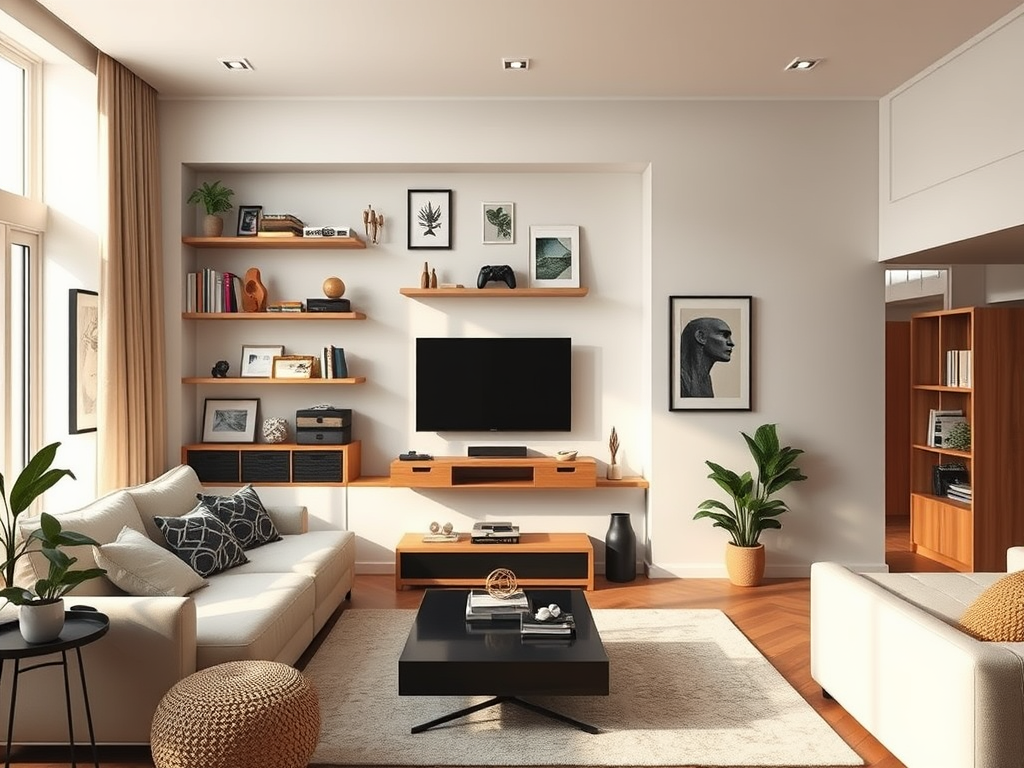
Husband’s Game Gear?
Give it a defined, proud, visible zone — not a corner you resent.
Why this works
- Maximalists feel respected
- Minimalists know the chaos won’t spread
- Every item finally has a home
Even a small shelf or LED-lit nook can transform arguments into appreciation.
Real Example
A couple avoided a full meltdown by building:
“The Game Command Center” —
one wall-mounted shelf, one cable box, neutral backlighting.
He loved it.
She loved the structure.
Marriage saved.
💛 3. Don’t Force Throwing Things Away — Add Meaning Instead
Minimalists often think:
“If we declutter, everything will feel better.”
But forcing discarding increases emotional resistance.
Instead, ask:
“What memory does this hold?”
“How can we display it in a way that honors its meaning?”
Ways to keep items without overwhelming the space:
- Memory boxes
- Rotating display shelves
- Framed collections
- Baskets with lids
- Photo-cataloging sentimental items
This shifts the conversation from “Get rid of it” to
“Let’s preserve it with intention.”
AI Isn’t Replacing Humans — It’s Transforming Broken Systems for the Better
💡 4. Make a Maximalist House Look Minimal — With Zero Decluttering
You don’t need fewer things.
You need better visual flow.
Three design tricks that work instantly:
✔ Warm or soft lighting
Even full shelves look calmer with diffused light.
✔ Repeating colors
If 60% of objects share one color tone, the room feels intentional.
✔ Grouping items
Many small things scattered around = chaos.
The same things grouped together = style.
These small touches allow a maximalist home to feel airy —
and allow a minimalist to breathe.
👫 5. Build a “Negotiation Routine” to Prevent Future Fights
Don’t wait until someone says, “This house is driving me crazy.”
Try a monthly, 15-minute check-in:
Questions to ask:
- What space feels stressful right now?
- What space feels great?
- What storage isn’t working?
- What can we adjust without changing personalities?
This turns home management into teamwork instead of conflict.
📌 Summary
✔ Main Point
Minimalists and maximalists can absolutely live together.
Not by choosing one style — but by creating shared systems.
✔ What Works
- Ownership zones
- Emotional meaning over forced decluttering
- Lighting & layout to calm busy spaces
- Monthly negotiation routines
⭐ Key Tips
- Respect beats minimalism.
- Systems beat arguments.
- Your home doesn’t need to be perfect — it needs to reflect both of you.
- Design is not about reducing personality.
It’s about helping two personalities coexist beautifully.
<< You Might Also Like >>
“Korea’s Secret Winter Escapes: Hidden Gems Beyond Seoul”
How a Small Act of Kindness Can Save a Caregiver’s Day
AI Isn’t Replacing Humans — It’s Transforming Broken Systems for the Better
Leave a Reply