
“At 71, some might think it’s an age to stop, but for me, it’s the perfect time to review the grand novel of my life and begin a new chapter. During quiet afternoons in Canada, I’ve started turning the countless people and landscapes I’ve observed over the decades into words. More important than the technical rules of writing a novel is how we view our own lives. Today, I want to share the essence of storytelling that I’ve discovered through my own journey.”
AI Isn’t Replacing Humans — It’s Transforming Broken Systems for the Better
Let’s start with the conclusion:
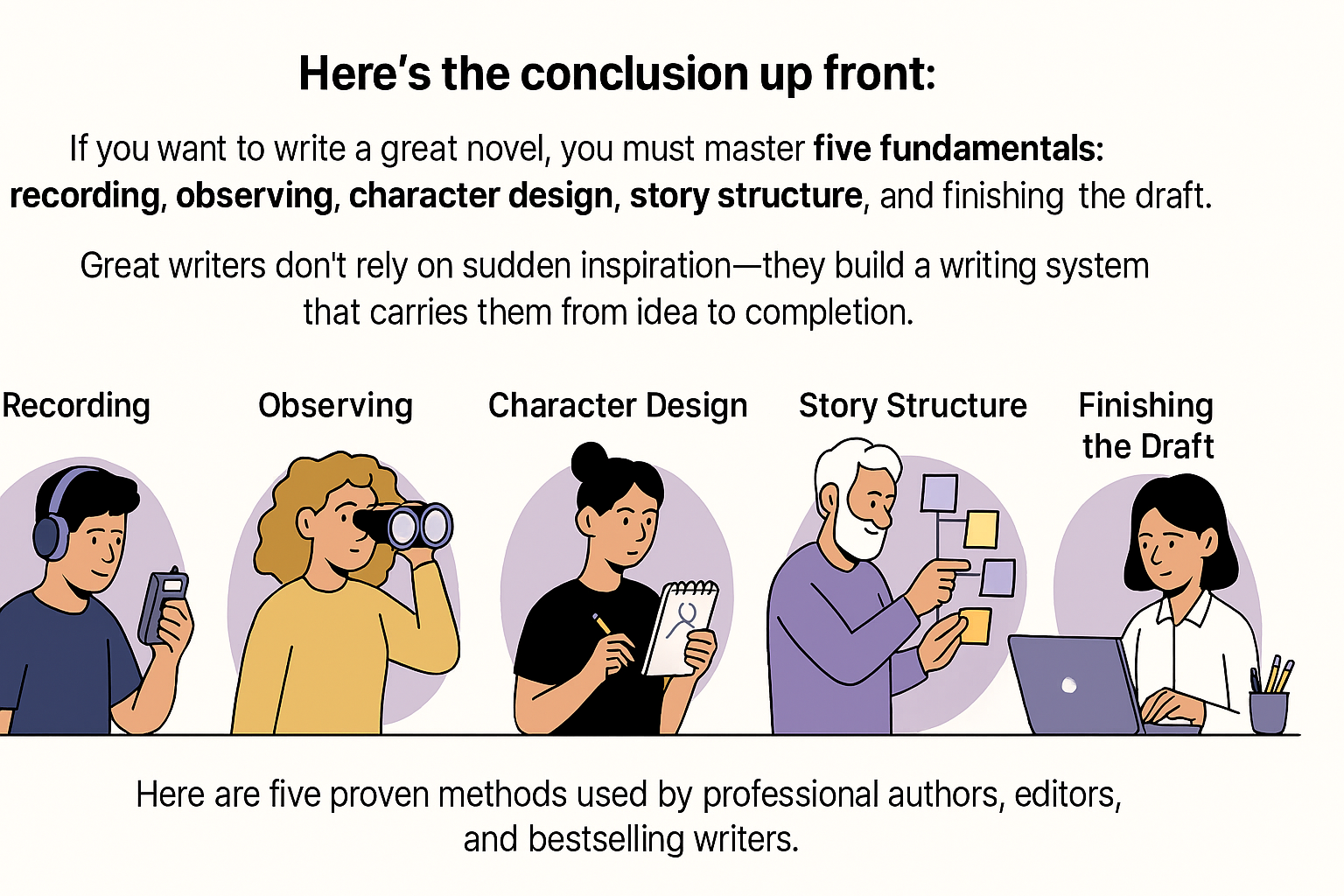
If you want to write a great novel, you must master five fundamentals: recording, observing, character design, story structure, and finishing the draft.
Great writers don’t rely on sudden inspiration — they build a writing system that carries them from idea to completion.
Here are five proven methods used by professional authors, editors, and bestselling writers.
1. Great novels begin with observation — it’s 50% of writing
“In my daily life in Canada, I often sit at a local cafe, observing the diverse faces and listening to the rhythm of conversations. These small moments are the seeds of my stories.”
A novel isn’t created from imagination alone.
Good writers are excellent observers of people, behavior, conversations, and small emotional details.
How to strengthen your observation skills
- Keep quick notes in your phone whenever something catches your attention
- Observe people in cafés, trains, and public places
- Save interesting sentences, metaphors, or expressions
- Write down moments when your emotions shift
Almost every author is a “note-taking machine.”
Without observation, creativity dries up.

2. Build your characters first — the plot will follow them
One of the biggest mistakes beginners make is starting with plot first.
But the strongest stories come from characters who want something, fear something, and make meaningful choices.
A simple character-building checklist
- What is their deepest emotional wound?
- How does that wound shape their decisions?
- What do they want (Goal)?
- What blocks them (Conflict)?
- What impossible choice must they face (Dilemma)?
If your character is alive, your story will write itself.
The Omnivore Generation: Taste Without Borders
3. Use the 3-Act Structure — it’s simple, universal, and effective
The 3-act structure is the backbone of almost every bestselling novel and Hollywood screenplay.
It’s simple enough for beginners and powerful enough for experts.
The 3-act structure at a glance
Act 1 – Setup
- Introduce characters
- Present the world
- Trigger the central conflict
Act 2 – Confrontation
- Rising conflicts
- Relationship shifts
- Character growth or breakdown
Act 3 – Resolution
- Final choice
- Consequences
- Emotional closing
If you learn only one structure, let it be this one.
4. Dialogue is a character’s fingerprint — give each person a distinct voice
Readers fall in love with characters through dialogue.
If all characters sound the same, the story feels flat.
Tips for distinct character voices
- Vary sentence length
- Let each character use unique phrases
- Add verbal habits (“Actually…”, “You know,” “Well—”)
- Capture how people really talk, including pauses and rhythm
Dialogue is not decoration — it’s personality on the page.
5. Your first draft can be messy — what matters is finishing it
All professional writers agree on one thing:
“A messy draft is better than a perfect idea.”
Half-finished novels teach you nothing.
A completed first draft teaches you everything.
A simple completion system
- Set a daily writing time (even 10 minutes)
- Write 300–500 words a day
- Do NOT edit your first draft
- Revise only after the draft is complete
Draft → Edit → Polish
This three-stage process is the actual writing formula.
📝 Summary & Key Takeaways
Quick Summary
- Observation builds creativity
- Characters come before plot
- Use the 3-act structure for clarity
- Dialogue must differ between characters
- Finishing the draft matters more than perfection
Key Tips
- Make note-taking a daily habit.
- Build characters with emotional depth.
- Keep your story structure simple.
- Use dialogue to reveal personality.
- Prioritize completion over perfection.
<< You Might Also Like >>
“Korea’s Secret Winter Escapes: Hidden Gems Beyond Seoul”
Warm Digital: Re‑Interpreting Scripture and Compassion in a Lonely, Modern World
Stream Your Favorites Faster & Better! 📺
Why wait? Upgrade to Amazon Fire TV and enjoy lightning-fast streaming and thousands of apps at your fingertips. It’s time to level up your TV game! 🚀
Leave a Reply